Signal
Loading the stream…
WDSF 2026 results are on record — 10 awards · 11 winnersSee the record →
Loading the stream…
What’s moving in agentic workstations and workflows — drawn from a reviewed source list, scored, and kept at a permanent address you can cite.
Curated and full layers · newest first · scored, sourced, citable
The ledger as a map. Dashed edges are machine-suggested (embedding similarity and duplicate clusters); solid edges are editorial — they appear only where a blog post cites an entry.
Raw data: signal-graph.json
Filter by category
37 entries in the curated layer matching the current filters
A five-year interview study (2021–2025) with 17 Chinese digital painters tracks how they negotiate human versus AI authorship over time, identifying patterns of protective resistance, pragmatic task delegation, and reflective agency repartitioning. The authors propose 'longitudinal agency partitioning' and suggest design implications for boundary controls, provenance, and authorship norms.
Five-year longitudinal interview data on how creative practitioners actually redraw the human–AI boundary over time is rare; the design implications for boundary controls and provenance transfer to agentic workflow design.

GitHub now lets repository rulesets block pull requests from merging when the PR introduces exposed secrets, scaling secret-detection protections across repositories.
One configuration change in repository rulesets adds an enforceable merge gate against leaked credentials, with no extra tooling required.
Introduces PROS, an interactive editor for scientific posters that addresses the 'articulation gap' by letting the system surface source-grounded candidate problems while users retain authority over which become repair goals. Includes PROS-Bench (120 papers, 320 PPTX posters) and reports VLM-rated diagnosis quality of 67.2/100 with 87.6% operator-verified target resolution.
Formalises the distinction between problem discovery and committed action in agentic editors, with a concrete benchmark and quantified evidence that the two can diverge.
A source-code anatomy of eleven production coding agent harnesses (Claude Code, Codex CLI, Gemini CLI, Aider, OpenHands, etc.), mapping seven canonical subsystems with minimal and maximal implementations, cataloging 29 recurring design patterns, and including a longitudinal sample showing convergence over one quarter. Closes with 18 design recommendations and a minimum-viable-harness scaffold.
First systematic source-code dissection of major coding agents across ~4M LOC, yielding concrete patterns and a 90-line scaffold readers can actually build from.
BridgeGuard is an air-gapped, edge-deployed agentic RAG system for FHWA bridge inspection compliance. It combines vector search over regulatory guides with SQL queries on NBI data, orchestrated by a multi-step ReAct agent. A section-aware chunking method preserves regulatory item boundaries, yielding 94.2% chunk integrity versus 28.4% for naive splitting, and 99.77% accuracy on Delaware's 874-bridge inventory.
Demonstrates a fully offline, multi-step agentic RAG pipeline that meets regulatory compliance at edge scale. The chunking comparison and ablations are directly applicable to other field-based compliance workflows.

Addy Osmani shares principles for engineering AI agent loops, emphasizing well-defined goals and the discipline of retaining human judgment rather than fully delegating decisions to agents.
A senior practitioner's framework for keeping human oversight intact inside agent loops — concrete design pattern, not abstract theory.

LangChain benchmarked NVIDIA NeMo Switchyard, an open-source model router, on 145 agent tasks. Only 7% of turns required a frontier model, with a 30B-parameter model handling the remainder. Routing between Nemotron 3.5 Lightning and Claude Opus 4.8 cut total cost by 74% while retaining 93% of Opus's accuracy.
Firsthand benchmark with concrete numbers. Gives teams a defensible cost-optimization strategy for agent LLM calls and a decision formula for adopting model routing.
OpenAI CFO Sarah Friar shares five lessons for building an AI-native finance function, covering automated forecasting, stronger controls, and measuring AI ROI.
Firsthand account from a major tech CFO on operationalizing AI inside a core business function, with concrete patterns other teams can adapt.
Three preregistered human-subjects studies (n=923) examine how to visualize qualitative confidence alongside statistical confidence intervals in line-chart forecasts. The work compares text, icons, and integrated encodings such as color, transparency, and a blurred-stroke design, finding that non-textual methods can shape non-expert decision making and yielding design guidelines.
Preregistered design study with a large sample and replicable findings on which visual encodings for qualitative confidence actually shift non-expert decisions, plus concrete guidelines for forecast chart designers.
Peer-reviewed paper proposing a behavior- and height-based dynamic seat adjustment model that generates coordinated low-frequency seat trajectories aimed at reducing subjective discomfort during prolonged public-transport sitting. The model is preliminarily validated.
Primary-source ergonomics research on dynamic seat motion. Useful as a methodological reference for desk-seat or workstation seat designers, though the study context is public transport rather than office work.
Peer-reviewed Human Factors study comparing a large set of specific job rotation schemes, measuring biomechanical risk, body discomfort, and psychosocial demands to assess effectiveness at reducing musculoskeletal disorder risk among workers.
Empirically compares many rotation schemes rather than endorsing rotation as a blanket control, offering evidence for designing rotation cycles in desk-based and mixed-task work.
FOCAL is a privacy-first, on-device multi-agent system that turns continuous desktop interaction streams into task-organized personal logs. A Filter, Brain, Record, and Memory agent cascade cuts token use by 60.4% and VLM calls by 72.3%, and on DesktopBench it holds Task Accuracy at 0.81 under A→B→A interruptions versus 0.03 for the baseline.
Specific multi-agent architecture for on-device desktop summarization, with a benchmark showing task-isolated memory keeps accuracy where a baseline collapses on interruptions.
Pre-registered, identity-masked experiment with 44 economics meta-analysis authors: a single-pass frontier model report was preferred over two multi-agent debate tools, despite debate using roughly thirty times the tokens. AI judges nearly always placed real journal referee reports last.
Empirical counter-evidence to multi-agent debate hype: the simpler single-pass approach won on author-judged usefulness while using 1/30th the compute, and AI judges disagreed with the authors' ranking.
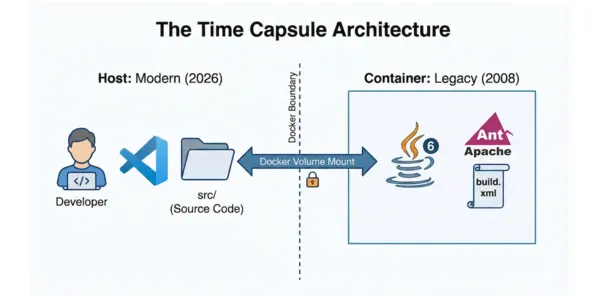
Article describes modernizing a 20-year-old Java 1.5 codebase using AI assistance combined with stable Docker environments, test-guided incremental refactoring, and evidence-grounded prompts. Early LLM attempts produced plausible but incorrect results; success came from constraining AI with codebase evidence and a step-by-step strategy.
Concrete anti-patterns and a disciplined workflow for using LLMs on legacy code, drawn from a real modernization project rather than theory.
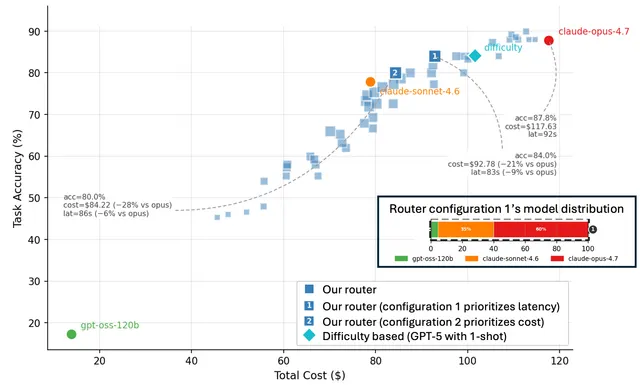
IBM Research describes challenges in model routing for agentic systems. Testing 417 tasks on AppWorld Test Challenge with the same CodeAct agent, Claude Sonnet 4.6 cost $79 total while GPT-4.1 cost $155, despite lower token pricing. The difference stems from cache-hit economics: Sonnet's lower cache-read pricing made it cheaper for context-heavy agent workloads.
Counterintuitive cost data from a 417-task benchmark shows caching, not sticker price, drives real agent-system economics. Reframes routing as systems optimization, not classification.
Retrospective on teaching an upper-level visualization course with AI coding tools, using prompt injections, oral checkouts, and two AI coding labs. Half of students had prior AI use; refinement dominated prompting logs, explanation was almost absent, and 56.4% preferred scaffolded instructions. Final projects were more polished but visually homogeneous.
Concrete management techniques (prompt injections, oral checkouts, scaffolded prompts) backed by real course data — reusable patterns for structuring AI-augmented work or teaching.
LangChain describes treating agent improvement as a data mining problem: mining execution traces to find failures, fine-tuning smaller open models as judges to process trace data at scale, and using evals to hill-climb agent performance through continual learning loops.
Frames agent improvement as an iterative data pipeline rather than prompt tweaking, with concrete hooks for teams already running agents in production.

Anthropic details the agent scaffolding built around an upgraded Claude 3.5 Sonnet for the SWE-bench Verified benchmark, where it scored 49% versus the prior 45% state of the art. The post explains how the agent navigates repositories, edits code, and runs tests to resolve real GitHub issues.
First-party breakdown of how Anthropic structures a coding agent around Claude, including tooling and evaluation harness details that practitioners can adapt.

Anthropic introduces Contextual Retrieval, a method that prepends chunk-specific context before embedding and BM25 indexing. It reports a 49% reduction in failed retrievals, rising to 67% when combined with reranking, improving RAG system performance.
Primary-source technique with quantified benchmarks and implementation guidance, directly applicable to RAG pipelines.

Anthropic's engineering team introduces 'context engineering' as an evolution beyond prompt engineering, framing context as a finite resource that must be holistically curated to reliably elicit desired behavior from LLM-based agents.
Official Anthropic framing of the shift from prompt engineering to context engineering — a paradigm worth tracking for anyone building agent systems.

Anthropic describes how it contains Claude agents across claude.ai, Claude Code, and Cowork as agent access expands. It reports that users approve roughly 93% of permission prompts, finding human-in-the-loop supervision insufficient alone, and outlines containment strategies for capping blast radius.
Firsthand engineering write-up with internal telemetry and concrete containment patterns for safely granting agents broad access.
A controlled experiment finds that higher variance in AI-generated design sets increases selection of center-proximal options, revealing central tendency bias in multi-variation interfaces that constrains selection diversity in human-AI co-creation.
Identifies a specific cognitive bias in AI co-creation interfaces, with direct implications for how multi-variation selection tools should be designed.
Hamel Husain compared 100 human-annotated traces against automated eval systems for AI agents and reports the findings on when automated evals succeed or fail versus human judgment.
Empirical benchmark of 100 traces against automated evals is a rare data point; readers building agent pipelines can calibrate where to trust automated scoring versus human review.
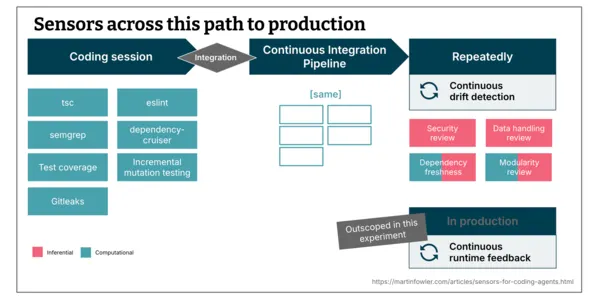
A walkthrough by Birgitta Böckeler on using computational sensors—test suites, ESLint, and static analysis—as feedback mechanisms for AI coding agents. Building on her earlier harness-engineering model, it focuses on keeping AI-generated codebases maintainable by catching internal-quality regressions before human review.
Firsthand framework for guarding code quality in agent-driven workflows. The sensor/harness mental model is a concrete addition to anyone deploying coding agents on real codebases.
Thoughtworks practitioners argue that 'vibe coding' with AI agents produces insecure software because agents default to the path of least resistance. They recommend security context files, vetted AI permission requests, daily security intelligence feeds, and secure-by-default templates to move prototypes to production safely.
Names a concrete gap in current AI-coding discourse and lists actionable guardrails any team shipping agent-generated code can adopt immediately.

A workflow pattern in which an LLM is prompted to interview a human in order to assemble the context a downstream LLM session needs, replacing a hand-written context document with an interactive Q&A that captures requirements, guidelines, and external references.
A named, reusable pattern from an authoritative source for building LLM context through interactive interrogation rather than manual document drafting.
Martin Fowler's site highlights Lattice, an open-source framework by Rahul Garg that embeds engineering disciplines (Clean Architecture, DDD, secure coding) into AI-assisted programming via composable three-tier skills and a living project context layer. Also notes a Q&A addition to colleagues' Structured-Prompt-Driven Development article.
Curates a concrete, installable framework that addresses AI coding assistants' core failure mode — silent design decisions and unvetted output — via a layered structure teams can adopt or fork.
Martin Fowler annotates Chris Parsons' third update to his guide on using AI for coding. Key shifts discussed: 'verification' has moved from human code-reading to automated gates (tests, type checkers) as agent throughput rises. Parsons distinguishes vibe coding from agentic engineering and recommends Claude Code or Codex CLI, citing their inner harnesses as a key advantage.
Fowler-curated update on AI coding practices with a concrete reframe of what 'verified' now means under high agent throughput — directly useful to engineering leads and practitioners structuring AI-assisted work.
Martin Fowler highlights Thoughtworks Technology Radar Vol 34, an 118-blip survey dominated by AI topics. Key observation: AI is pushing developers back to software fundamentals like pair programming, clean code, mutation testing, and DORA metrics, and reviving the command line as agentic tools make the terminal a primary interface.
Useful as a curated cross-section of what is working in real teams; the framing of AI driving a return to command-line and foundational craft counters the usual tool-acquisition narrative.
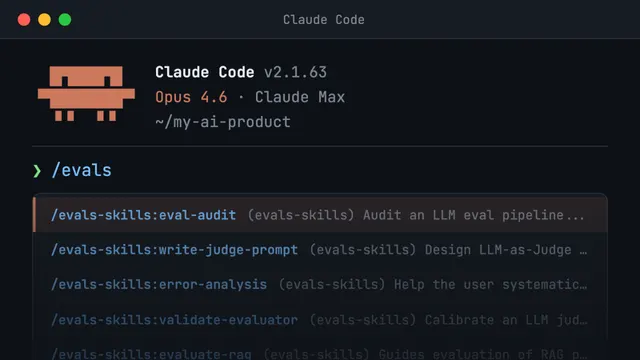
Hamel Husain publishes "evals-skills," a set of skills that instruct coding agents on how to perform AI product evaluations. The skills complement vendor MCP servers by teaching agents to analyze traces and experiments. The first skill, eval-audit, inspects existing eval pipelines and produces a prioritized list of problems with next steps.
First concrete skill pack for delegating eval work to coding agents, from a practitioner with 50+ company engagements. Fills the gap between eval platform access and knowing what to do with it.
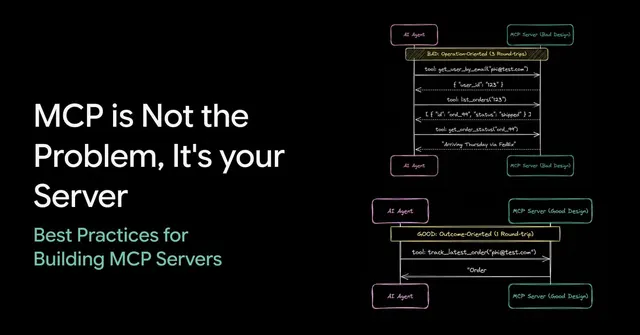
Phil Schmid argues that widespread dissatisfaction with the Model Context Protocol (MCP) stems from poor server implementations rather than flaws in the protocol itself, and outlines best practices for building effective MCP servers.
Blaming the protocol is common but misplaced — this is a concrete engineering checklist for building MCP servers that actually work in production agentic setups.
Ethan Mollick reports on early observations of GPT-5, focusing on its ability to take initiative and complete multi-step tasks autonomously rather than waiting for detailed human instruction at each step.
Firsthand account from a trusted practitioner on what letting GPT-5 act on its own judgment actually looks like in practice, with implications for delegating whole workflows.
Official MCP blog post providing a practical guide to building workflow automation using MCP prompts and resource templates, demonstrated through a meal planning example.
Official walkthrough of MCP prompts and resource templates, with a concrete meal planning example showing how to structure agent-driven workflows.

A comprehensive FAQ from Hamel Husain distilling questions from teaching LLM evaluation to 700+ engineers, covering product evaluation systems, building LLM-as-a-judge, error analysis, synthetic data curation, and rapid improvement workflows for AI products.
Battle-tested evaluation methodology drawn from teaching hundreds of teams, with concrete steps for LLM-as-a-judge, error analysis, and synthetic data.
Hamel Husain distills patterns from consulting with 30+ AI teams. The core claim is that successful teams obsess over measurement and error analysis rather than tools and frameworks. Key practices include systematic error analysis, investing in simple data viewers, empowering domain experts, using synthetic data, and tracking experiments rather than features on the roadmap.
Practitioner-tested methodology drawn from 30+ engagements. Concrete patterns for error analysis, evaluation, and team workflow that address why many AI projects stall before delivering measurable value.
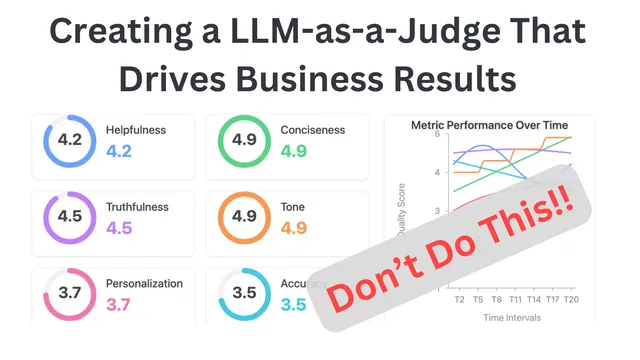
A practitioner's guide to using LLMs as judges for evaluating AI outputs, based on experience with 30+ companies. It identifies common pitfalls such as excessive metrics, uncalibrated scoring scales, and ignoring domain experts, then introduces a step-by-step 'Critique Shadowing' method beginning with identifying a Principal Domain Expert.
Concrete evaluation framework grounded in cross-company consulting experience. The Critique Shadowing method gives a specific alternative to dashboard-driven eval approaches that produce untrusted metrics.
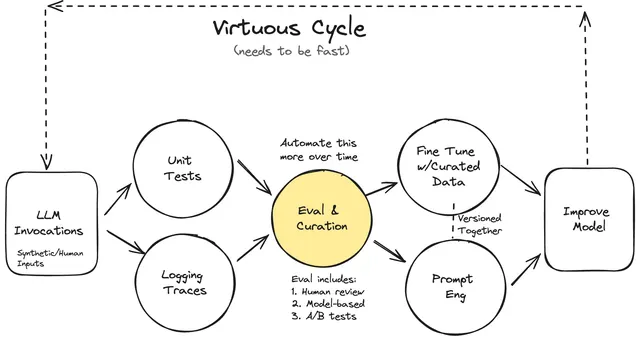
Practitioner essay arguing that robust evaluation systems are the missing foundation in most LLM product efforts. Uses a real estate AI assistant case study (Rechat) to walk through building eval pipelines, inspecting data, and iterating quickly on prompts and models.
Hands-on, case-study-driven playbook for building LLM evals from a working consultant. Useful reference for anyone shipping domain-specific AI products.
