Work is changing. Your space is how you answer.
Following that change — through real workspaces, live signals, and a yearly festival.
WDSF 2026 — winners on record
Off-season · See the 2026 results
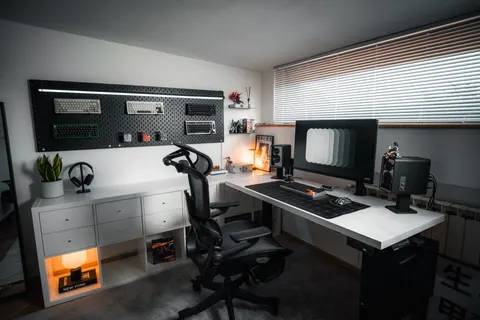
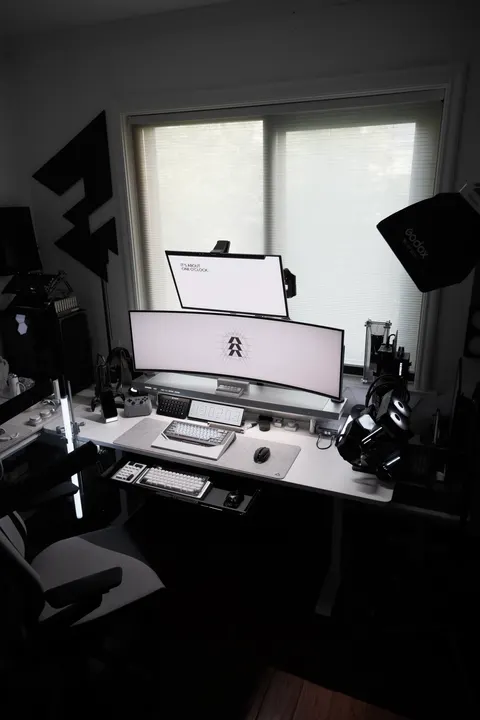
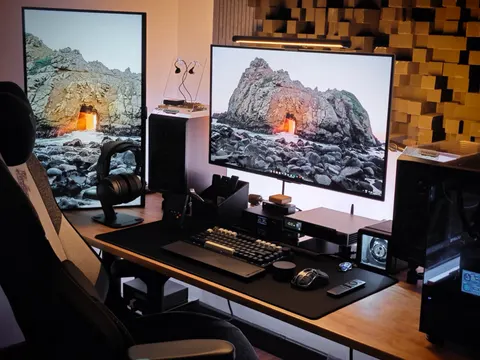
Desk Setup of the YearChen Sifan · Hangzhou, China · S·0068

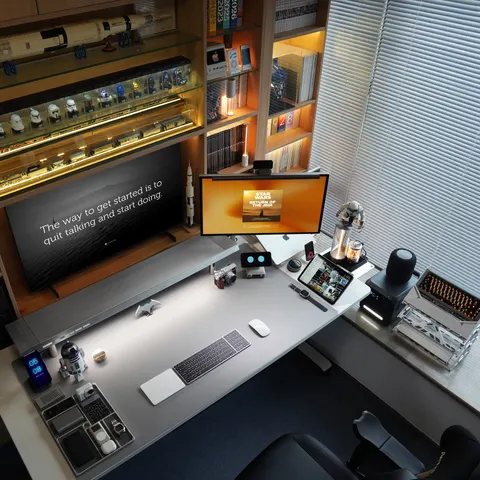
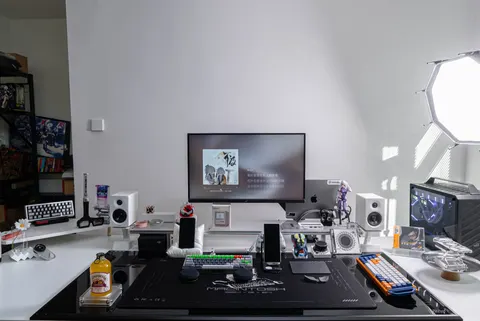

Why this ledger exists
- 01
Judgment and taste
When AI does more of the doing, the human part of work gets sharper — judgment, taste, direction.
- 02
An observation post
AI is rewriting the workday in real time. Beyond Desk watches where that change becomes physical.
- 03
Authorship
How you work is becoming something you design, not something you are given.
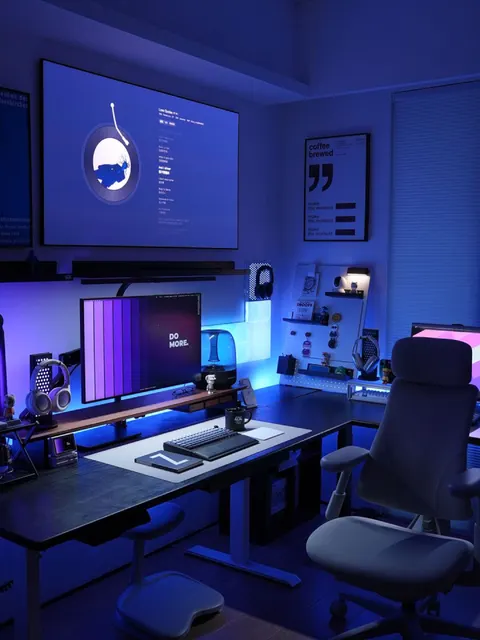
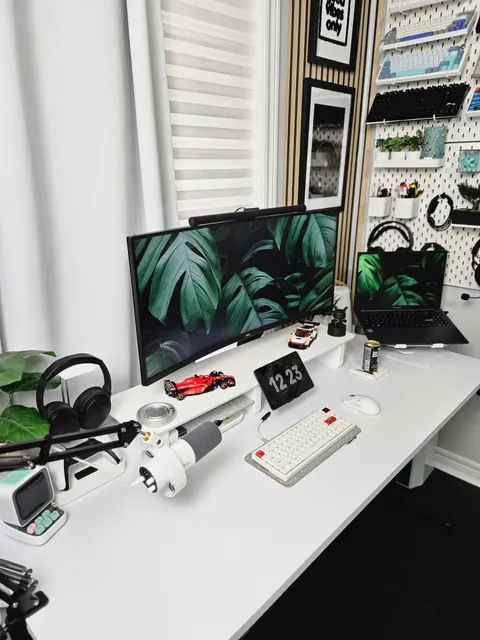
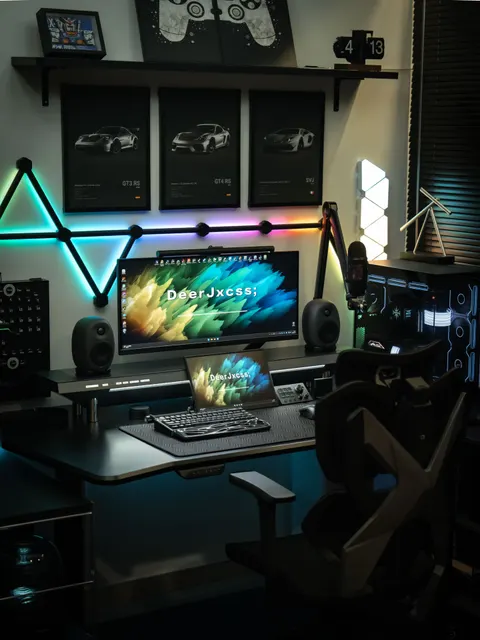
Setups. 179 real workspaces, logged as submitted — people first, gear second.
browse all →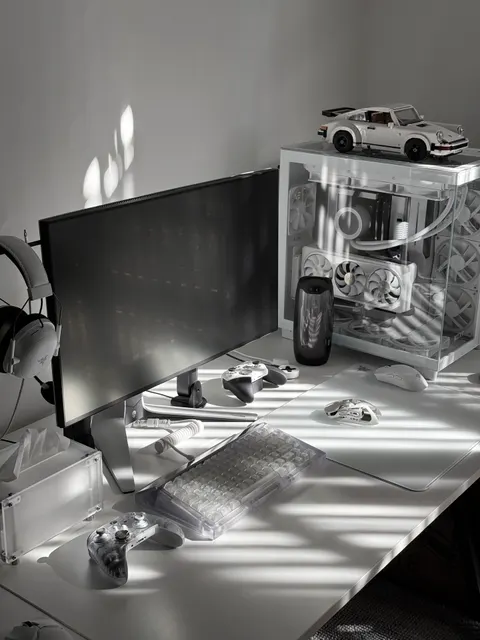 S·0057Student遇到困难睡大觉 · Sydney, Australia
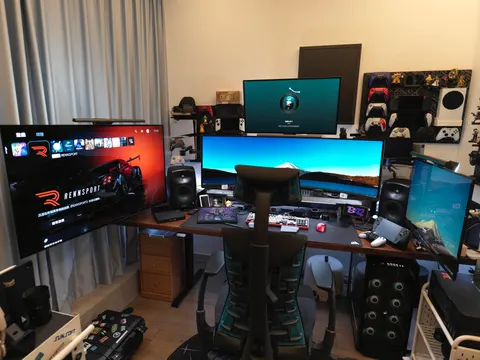 S·0121Software developerMars Xiang · Shanghai, China
 S·0051Flight attendant一只狗 · Shanghai, China
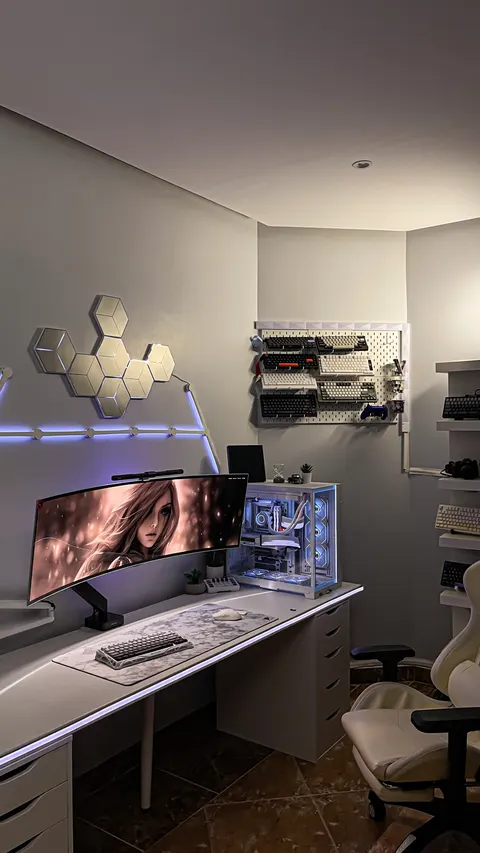 S·0052Abdullah bin Mohammad · Saudi Arabia
 S·0053PhotographerAkayu · Guangzhou, China
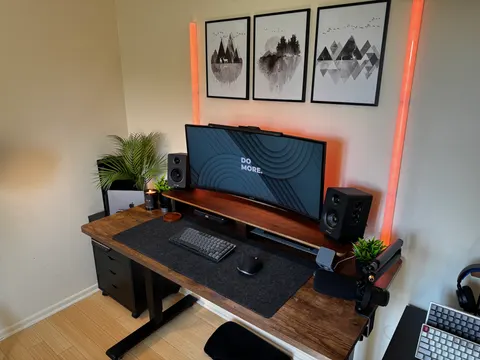 S·0054EducatorAlana (The Simple Norm) · United States
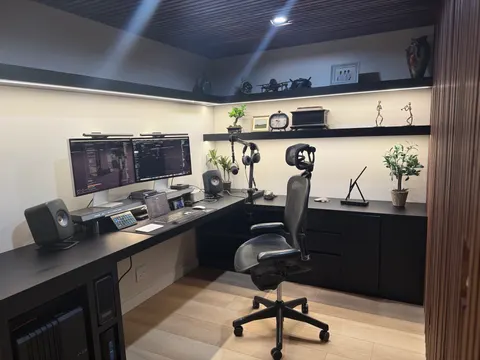 S·0055Software EngineerAlex · Boca Raton, FL
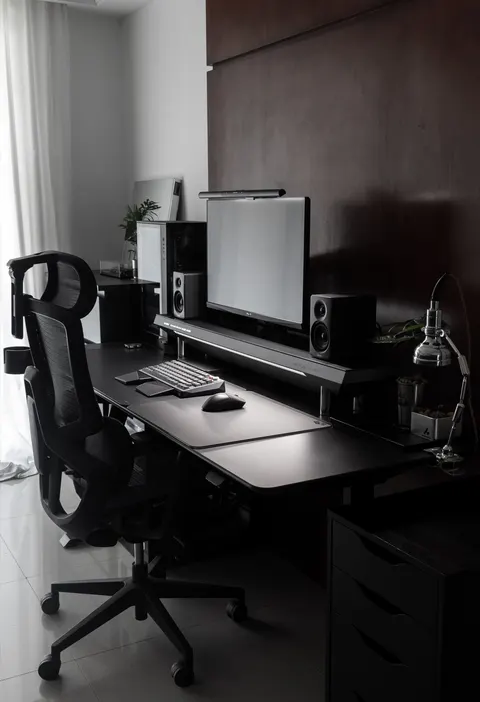 S·0056Product designerAlex Richard · Dongguan, China
Scan. The one tool here that reads your own desk — a private AI report, by email.
scan your desk →One photo, read as a working system — scored 1–5 on the same four dimensions the festival uses, each with a written reason.
- ReportArrives by email — no total, no ranking
- PrivacyPrivate to you — kept out of the gallery and the registry
- StorageHeld in access-controlled storage, then deleted on a fixed schedule
The four dimensions it reads
- 01Work-mode fitDoes the layout serve a believable, describable workflow?
- 02Spatial narrativeCan a stranger read the person and place from the frame?
- 03Craft & executionHow completely is the intent finished — not how much it cost?
- 04AuthenticityA space in real use, or staged for show?
Blog. Thinking built on the evidence — essays and notes reasoned from recorded signals.
all entries →- B·0005
Safe models do not compose into safe systems
Six papers in two weeks converge on one engineering fact: safety measured on a single agent does not survive wiring agents together. The failure lives in the joints — memory, context, setup files, and the management layer itself.
- B·0006
Delegation regret is measurable now
Three studies put structure on a feeling agent users know well. The precise version: people regret the scope an agent took, not the errors it made.
- B·0004
This week in the record: agents are leaving the IDE
Six recorded entries from one fortnight point the same direction: the coding agent's home is no longer the editor buffer. It is Slack, Linear, the issue tracker, the phone.
Evidence graph
The ledger as a map. Dashed edges are machine-suggested (embedding similarity and duplicate clusters); solid edges are editorial — they appear only where a blog post cites an entry.
- cites — editorial citation (blog post → entry)
- related — machine-suggested (embedding similarity)
- cluster — same story, archived duplicate
Text index of this graph (2552 entries)
AI hardware & peripherals
- Adjust your Navigator Trackball angle and sensitivity
- iFLYTEK P1 Pro: The AI-powered recorder slash lighter
- DIY Voyager Angled Keycaps
- Layout Buffet - Backlighting
- INNOCN CB32U1 review: An affordable alternative to the Apple Studio Display?
- Flagship convertible with Snapdragon X2 Elite - Microsoft Surface Pro OLED 2026 Review
- Excellent business laptop with 64 GB RAM - Lenovo ThinkPad T14s Gen 7 AMD Review
- June Roundup of Navigator Updates
- Layout Buffet - Hyper, Meh, and Software Shortcuts
- DIY Navigator Moonlander Shells
- DIY Moonlander Wrist Rest Pad
- DIY Navigator Trackpad Shells
- iFLYTEK AI Recorder P1: An AI assistant as a wearable device
- AI at the Edge is a different operating environment
- HP Reveals Keyboard Computer with Ryzen AI Chip
- Keychron's Nape Pro turns your keyboard into a laptop‑style trackball rig
- Exploring Different Keyboard Sensing Technologies
- Toucan Wireless Split Keyboard with Touchpad
- OpenAI and Broadcom unveil LLM-optimized inference chip
- 192GB of VRAM in One PC… The Cheap Way
- AMD Built the DGX Spark Rival I Predicted… But There's a Catch
- Building the World’s Smallest AI Workstation
- Most Powerful 16" Gaming Laptop Has a Secret
- NVIDIA RTX Spark Made Everyone Mad
- 3 New PCs, One Giant AI Model… This Shouldn’t Work
- Three months wrong about why my 4-node AMD cluster was slow
- The Non-NVIDIA AI Card Everyone’s Ignoring
- INSANE $1000 32GB VRAM Local Ai Server
- $1500 Local AI Server Build Tested with Hermes Agent Gemma 4 and Qwen 3.6
- This $129 AI Storage Server Upgrade Saved Me $2,800
- BEST Local Ai Motherboard CPU Combo You've Never Heard Of
- KEEP AI LOCAL! Explaining Agentic AI and The Loop: FT MSI Cubi NUC+ and the MSI EdgeXpert Mini PCs
- Is STRIX Better than SPARK? Now Launching w/new Software: AMD's Ryzen AI Halo Developer Workstation
- NVIDIA's Secret Windows Upgrades for N1/N1X Laptops Help Everyone; AMD Could Benefit the Most
- Minisforum's N5 Max is an Absurd NAS
- Analyzing Nvidia GB10's GPU
- Inside Nvidia GB10’s Memory Subsystem, from the CPU Side
- Nvidia’s B200: Keeping the CUDA Juggernaut Rolling ft. Verda (formerly DataCrunch)
- Today was the perfect day for Poolside to drop Laguna S 2.1 because I just got these in! Finally have a half decent amount of VRAM. 3x V620 = 96 GB.
- RTX 5090 and 5080 Ran the Same Local AI Until the VRAM Ran Out
- Got these baddies in the mail today (2X 3080 20GB)
- Apple’s Hidden AI Model… The Speed they never showed
- Apple M5 isn't making full use of its matmul cores yet
- How much are RTX PRO 6000s going for in your country/state?
- PSA: DO NOT use Intel consumer platforms for multi-GPU setups
- Building the World’s Smallest AI Workstation
- Taking a Look at Gigabyte's MW94-RP0 Xeon 6 E-ATX Motherboard
- Is it worth getting 128GB MacBook Pro? Will it ever be comparable to today’s frontier models for coding?
- AMD Says 2 Ryzen AI Halos Can Run a 400B Model... I Tested It
- World's First(?) Underwhelming AMD Ryzen AI Halo Cluster
- AMD Strix Halo with 32 GB RAM for $1899 - Asus ProArt PX13 2026 Convertible Review
- A user has managed to run Kimi K3 on 80xRTX 5090, via 25GbE Ethernet.
- My second Inspur AGX-2 with another x8 v100 arrived!
- PCIe Gen6 and Gen5 Will Both Matter for AI Storage
- DGX Station running GLM5.2 in VSCode
- ASUS Showcases NUC 16 Family Powered By Panther Lake
- "Data center in a Box (on Wheels)" 256Gb VRAM/512Gb RAM AI Server 6-8 Month Operational Review, Stability Write Up, Benchmarks
- Checking Out The GMKTek X3 Strix Halo: More Strix Halo Shenanigans!
- SK hynix, In Collaboration With SanDisk, Unveils The New High Bandwidth Flash (HBF) Standard, Helping To Resolve AI Inference Bottlenecks, Targeting Up To 3TB/s Bandwidth
- Kimi K3 full model running on 16x GB10 cluster at 20+tps
- Powerful creator tablet with Snapdragon X2 Elite - Asus ProArt PZ14 Review
- Get AI max+ 395 laptop or wait for rtx spark?
- Google DeepMind reshuffle 🧠, Meta Muse Code 💻, Anthropic chip team 🧩
- We Upgraded Our ZOTAC 4090 24G to Have More VRAM!
- RTX 5090 Owner Built An Open-Source Tool That Shuts Down PC If It Detects The 12VHPWR Cable Drawing Too Much Power, But It Can Only Work On Specific GPUs
- A 10M IOPS Kioxia GP1 SSD Shown Running at FMS 2026
- Showoff Saturday: Local 4x 6000 Pro (multi-year progression)
- enabling PCI-E p2p for consumer Nvidia cards will yield you more than you think
- RTX 5090 96GB spotted on Alibaba?
- Underestimated budget solution: radeon 780m iGPU
- WisdPi WP-UT9 USB 10GbE Adapter Review
- Comu Action Pro: AI Assistant put to the test
- Comu Action Pro: AI assistant put to the test
- Show HN: A tiny LLM running at 21,000 tok/s on a $250 FPGA (Live Demo)
- Minisforum N5 Max Review with AMD Ryzen AI Max+ 395
- I built a weird, low-power llama.cpp server using an Intel N100 + RTX 5060Ti
- Ling-3.0-flash quant ladder on one DGX Spark: the whole thing sits in a 32 to 40 tok/s band
- Low Power AI Is More Efficient than NVIDIA // The AI Hardware Show S2E10
- OdinLake O3 WireControl ergonomic chair review: Better than the LiberNovo Omni?
- Nvidia doubles RTX PRO 6000 Blackwell's MSRP to a staggering $16,000 — 96GB card started pre-orders below $8,000 last year
- You could purchase a Desktop with 2TB of DDR5 - It only sets you back some $200k+
- 27-inch monitor with a 240 Hz IPS panel, G-Sync, and accurate colors: KTC H27E6S review
- M5 MacBook Air Against Every Generation for Dev Work
- This was a data center a year ago… Now it's on my desk
- This 13-in-1 USB-C docking station with built-in GaN+ charger changed my charging habits for the better — a review
- club-5060ti refresh: tested RTX 5060 Ti presets, a proper high-context harness, and Qwen3.8 27B
- MOKiN's 13-in-1 USB-C docking station has an actually useful gimmick and it turned my Lenovo Legion Go into a usable desktop PC
- Show-off Saturday: Intel Arc B140 build.
- The dream is to reach 200GB VRAM
- Qwen3.8-27B Q8_0 on Strix Halo is seriously impressive
- CDW has bumped the MSRP of the RTX Pro 6000 from $16,000 to $19,999
- Linux Improves VRAM Management in 7.3 Kernel 🥳
- This laptop with 64 GB RAM is perfect for AI agents: HP ZBook 8 G2a 14 review
- Alibaba's RISC-V CPU, XuanTie C950, Runs Qwen-3.8 27B at 30 tps
- Framework 13 Pro...Why Apple Solders Memory
- A Server with EIGHT GPUs? ft. ASRock R9600D
- Buying a V100/older NVIDIA GPU? Run this to check for older memory issues
- “The All Spark” Cluster: Upgrading from 16 - 36 DGX Sparks
- GMKtec is going to launch new hardware with Ryzen AI Max+ PRO 495 at IFA Berlin 2026
- With AI lumbar support, massage, heating, and cooling: Hbada X7 office chair review
- Apple M5 Server
- Apple introduces new Mac Studio with M5 Max and M5 Ultra - up to 512GB of unified memory
- Apple releases M5 ultra at 1.2TB/s bandwith
- Intel Arc Pro B60 Dual 48G spotted
- Mac Studio M5 Max Cost Analysis
- Mac Studio M5 Ultra is a DGX Spark Killer for Local AI
- 224GB of GPU Memory on 1 Desk and It Should Not Work
- EliteBook X Flip G2i 14 AI review: HP's strongest convertible yet is also one of the priciest
- [AINews] Hot Chips: OpenAI’s Jalapeño, Cerebras CS-5, Groq 3 LPX, Apple M6
- Let's Talk about SR-IOV and Proxmox on Intel Arc B60 and B70!
- I Built a Monster PC Just to Run AI Locally
- ROCm 10.0: A Decade of Open Compute, Built for the Age of Agentic AI
- Hot Chips 2026: Samsung’s Processing-in-Memory (PIM)
- Exo labs claiming 4.8 tb/s memory bandwidth through m5u Mac Studio clustering
- DGX Spark cluster
- It's official! 192GB Framework
- Ran Qwen3.8-Flash-Next (79 GB, 2-bit) at 350K ctx for 3.5 hours on a 128 GB M5 Max — speed vs context depth, 100 turns, one graph
- When you say, because I can. Limits of X870e
- Experience report - Qwen 3.8 Flash Next on memory rich, GPU poor setup
- NVIDIA® DGX Station™ Delivering Data-Center-Class Performance from the Desktop
- This $60,000 Mac Cluster Has a $10 Problem
- HP ZBook Ultra G1a 14 with Strix Halo review: A victim of the memory crisis?
- A very confusing report from Puget Systems
- HiDock P1 AI voice recorder hands-on review
- 2/5 of my CMP 170HX have died after 2 weeks and the 3rd came with defective tensor cores. Current prices DO NOT justify the risk you are taking
- GLM 5.3 Flash makes a black hole Minecraft mod running locally on 4x RTX PRO 6000 WS
- Could the shortage be getting better?
- Unholy Strix Machine! Doubling up with R9700s
- MINISFORUM MS-S1 MAX-P495
- GB10 Dgx Spark 2 Node Cluster From Scratch
- AMD unveils Threadripper Halo Station
- MSI EdgeXpert (DGX Spark) Unboxing
- NVIDIA didn't want me to do this
- Thinking about grabbing an RTX 2000 Ada 16gb to add to my gaming pc for inference due to Wattage constraints, any advice?
- Voice conversations between Gemma4 12B and E2B on GPU and Jetson Orin
- GPU guide (GB per dollar, bandwidth)
- Dell Pro 7 14 P714260 review: Sticking with Intel has its advantages
- Now this is a serious local machine
- Server rebuild to custom loop. 2x RTX Titans 24gb, 1x 22gb 2080ti | T: 70GB VRAM.
- 8 DGX Spark Cluster with this Switch
- Mac studio is an Anal powerhouse - time 0:04 in official video
- PCIe Geometry for the Minisforum MS-03
- What GPUs will give me GOOD speeds and on DSV4 Flash and similar models, and not have to run a mega quantized version? Budget around $15k-ish.
- nvidia rtx 5090 with 96gb of vram.
- Intel Linux NPU driver only now officially supports Ubuntu 26.04 LTS
- Should I sell my RTX 5090 for a Mac Studio M5 Ultra 96GB?
- I Ran A 27B Model On A Hand-Sized PC… Didn't Expect This
- 3k$ 128GB VRAM + 256GB RAM DDR4 Server
- Talk me out of buying a 3rd Spark
- Micron's memory wall chart. Compute up ~3x every two years, HBM bandwidth under 2x
- 5090 Stock is Almost Gone
- RTX PRO 5500 Blackwell (84GB) released
- What are the current best retail GPUs for max VRAM at a reasonable price?
- Show HN: Kinesis – Control your Mac with the Meta Neural Band
- NVIDIA Unveils RTX PRO 5500 "Blackwell" Workstation GPU with 84 GB GDDR7 Memory
- Got it unopened off Craigslist for $4k. Excited to start hosting my own models!
- Don’t buy a $9K RTX 5090.... instead.
- LACT PR to let NVIDIA gpus go lower than stock VBIOS limit (so below 400W for 5090, or below 250W for 6000 PRO MaxQ)
- The Only Local AI GPUs Worth Buying Right Now (Ranked)
- Upgraded my local setup with 2 rtx pros and it's amazing.
- 153 tok/s on 1x AMD Radeon R9700 running Qwen3.8 27b NVFP4, 470 tok/s @ 8 conc requests, Prefill @ 3,619 tok/s
- Installing 6 GPUs in a standard case rather than using an open-frame chassis.
- Bonsai 1.7B can solve simple physics problems on a 12 watt intel N97 at about 9.1 t/s
- 768gb vram for less than the price of one RTX 6000
- An AI Supercomputer On Your Desktop: Checking Out The MSI XpertStation WS300
- Qwen3.8-27B at 144 tok/s on an M5 Max MacBook Pro
- Qualcomm’s Adreno X2 GPU
- Radeon RX 10800 XT can outperform the RTX 5090 by 15-25% in 4K gaming and local AI
- 18 Arm Cores in 0.7 Liters… I Put It Next to a Mac mini
- Would you buy a Qwen3.8-27B Taalas chip for $1k if it could run at 7,000 TPS?
- Speed-up Kimi K3(2.8T) on a 16x GB10 Cluster — 30 t/s coding throughput, 136 t/s concurrency peak.
- M5 Ultra Mac Studio Review: The Dream Mac for Local AI Agents - MacStories
- Folks, have you purchased the Mac M5 Ultra with 256GB yet? We need serious benchmarks, because we only get YouTube clowns influencers results
- Show HN: Npunlock – Run custom C kernels for Intel NPUs
- 49-inch, flat, ultrawide and Mini-LED: Innocn E49M1R monitor for CAD and creative work in review
- Not big enough
- Asianometry: High Bandwidth Flash: What Is It Good For?
- 2400cc Inference Racer: Dual RTX 3090 motors, NVLink turbo, naked 7840U ThinkPad ECU, VW Golf radiator
- Navigating Cost Efficient Hardware in these Volatile Times
- Local AI GPU Prices are Spiking (Buy Now or Wait?)
- Anyone with experience using dual SXM2 to PCIe card?
- Updated from 3x3090(2x3090, 1x3090TI) to 2x5090
- I’m calling this the Monstrosity. 5 ex mining BC-250 boards Qwen3-Coder-Next Q4 at 40 tok/s
- Minisforum MS-S1 MAX-P495 @ €7.799,00
- 3090 for $1500???
- 3090 NVLink bridges: are there clones of these? why are they so insanely expensive?
- Is The ASUS Ascent QN10 the Snapdragon AI Mini PC of your Dreams?
- Debugging PCIe Link Retraining on an x8/x8 Splitter with Two RTX 3090s
- Do you need some extra memory on your DGX Spark?
- Qualcomm’s System Level Architecture in the Snapdragon X2 Elite
- AMD boosting AI/LLM performance for Radeon iGPUs as much as 18~23% with Linux 7.4
- Oído: speech recognition that beats Whisper-tiny, running on a $5 microcontroller (open source)
- Preorder for new AMD Ryzen™ AI Max 400 Series 192GB from framework just started
- You can now run Qwen 3.8 27B on AMD NPUs via FastFlowLM (at a killer 1 tps decode)
- Least to most expensive (Somewhat modern) GPU's with 32gb of vram (Under $1600) Based on ebay listings
- $5400 eBay 8x V100 server cranks on flash-next
- M5 Ultra vs 2 DGX Sparks… The Number You're Not Looking At
- Building an AI Workstation for Someone Else
- Update on the “Monstrosity”. 6 BC-250 board cluster
- Two 96 GB Ascend cards crun Qwen3.8-flash-next hardware notes, vLLM work, benchmarks, and what is next
- New 64GB DGX Spark. Significantly higher price for the original 128GB model $6,950 USD
- Is NVIDIA Insane? $4,999 DGX Spark 64GB
- I tried building a small RAG search node for Qwen3.8 27B using a fake AliExpress Mini PC... and Intel sent me back to 2018.
- MSI Stealth 16 AI B3WH review: Part Gamer, Part Creator, All Professional
- The curse of 64GB system RAM
- From 1x3090 to 20 DGX Sparks: my house fuses were the first bottleneck
- Qwen3.5 arch implementation in FPGA fabric for 9B/27B INT4 models on relatively cheap eBay mining hardware
- Make no mistake, selling 64 GB DGX Spark variants at the same cost as the original 128 GB is straight drug dealer behavior.
- 54gb vram for 35$
- cmpunlocker v0.5 just dropped, ECC support along with 4 extra SM unlocked for FREE, who needs a 64GB DGX Spark when you've got a CMP170hx right? 1.5TB/s memory BW vs 273 GB/s, all for less than 1/2 the price of a 64GB DGX Spark
- 2x CMP 170HX 64GB: GLM-5.3-Flash at 384K context / ~90 tok/s (EXL3, HBM-first setup) + Qwen3.8 comparison
- Surface RTX Spark Dev Box: The Dev Box Built For Developers
- $2800 rig with 8x Radeon Pro V620 (256 GB VRAM) + custom vLLM fork = Qwen3.8-Flash-Next at 60 to 100 t/s decode and 3000+ t/s prefill
- Bois, there's now a waterblock for the R9700. Quiet 4x or 6x builds are now possible.
- The Cheapest 4TB DGX Spark Alternative… ASUS GX10
- NVIDIA reportedly discontinuing RTX 5090, GB202 GPUs to be reserved for RTX PRO series
- No more RTX 5090
- Building a 4x R9700 setup for a 10 person startup
- Any takers for local llm? NVIDIA’s CUDA Moat Is Accelerating RTX Spark Laptop Sales, Higher 128GB Unified Memory Options Belonging To Surface Laptop Ultra Already Out Of Stock
- Customizable 3D Printable Navigator Shells
- NVIDIA RTX 5080 24GB reportedly launching in Q1 2027, board partners still waiting for details
- Hope the software support is good, but -> Intel Crescent Island Squeezes 1.3 PFLOPs Of FP8 Into Just 350W As D270 Targets The Competition With Value-Oriented LPDDR5X Up To 480 GB
- Sipeed announces MaixStation, comparable to Strix Halo and DGX Spark
- Got 2x DGX Sparks. Excited and confused!
- Introducing Kailh Choc Platypus switches
- 4x 6000 Pro for the company
- Someone is running Qwen 27B at ~20 tok/s on a jailbroken PS5's GPU
- DGX Spark ASUS Ascent GX10 Unboxing
- 4x R9700 builds with $127 used EPYCs: $10.7k all-in per machine. I built three (384GB VRAM)
- DGX Spark DELL GB10 Unboxing
- Nvidia RTX Spark Analysis - Finally an answer to Apple's M5 Pro & M5 Max?
- Smaller than the DJI Mic Mini – with a handheld mic trick: Elgato Wave Go review
- What a £300, 35W Snapdragon mini PC can actually do 👀: 35B coder at ~30 tok/s, and an 80B model that doesnt even fit in RAM running at 17 tok/s
- Our Gold Standard AI Tesla V100 Build in the Cooler Master Mastercase Mesh Gold
- 128GB RTX Spark laptop for $3832.
- **DeepSeek-V4-Flash-0731 on 4x Radeon AI PRO R9700 with affinity: the "refused" 4-card config works, ~79 tok/s on real cards**
- Asus ProArt P16 RTX Spark Laptop Review - The future of multimedia laptops?
- Reviewing the NEW ASUS ProArt P16 RTX Spark Laptop
- NVIDIA Put a DGX Spark in a Laptop… Almost
- Show me your rack
- Nvidia has officially confirmed that the 5090 is not discontinued and will continue shipping.
- DGX Spark Dell GB10 2 Node Cluster
- Modify and load custom VBIOS on Windows and Linux, on Blackwell 2.0 (RTX 50 Series)/Ada(RTX 40 Series)/Ampere (RTX 30 Series) without flasing, for example to lower power limits (and which cards were tested)
- PSA: Power limit your 5090s!
- Microsoft Surface Laptop Ultra RTX Spark Review - The 2000-nits Mini-LED panel is a problem
- I built an RK3588 NPU runtime without any proprietary inference libraries: Qwen3.5-4B at ~10 tok/s, ~2x faster than vendor SDK.
Agentic workflow patterns
- A couple of days ago, I sat down with Vivek Bharathi and dumped my brains. Here's the interview...
- a sneak preview behind an embedded software factory. I suspect rapid application dev is back
- porting software has been trivial for a while now. here’s how you do it.
- don’t waste your back pressure
- teleporting into the future and robbing yourself of retirement projects
- everything is a ralph loop
- Note #728
- The twilight of the chatbots
- Claude Dispatch and the Power of Interfaces
- Three Years from GPT-3 to Gemini 3
- The Shape of AI: Jaggedness, Bottlenecks and Salients
- Management as AI superpower
- A Guide to Which AI to Use in the Agentic Era
- Why AI Infrastructure must evolve for Agent Experience — Akshat Bubna, Modal CTO
- [AINews] Lilian Weng summarizes 35 papers on Harness Engineering for RSI
- Vercel's Andrew Qu on why agents are a new kind of software
- The website of the future may assemble itself for every visitor
- Skill engineering and the case against one-shot AI design
- How Cursor deploys AI inside the enterprise
- Warp CEO Zach Lloyd on why software factories are the next phase of coding
- Autoresearch: The feedback loop behind self-improving agents
- Forward Deployed Engineers and the future of software engineering
- AIEWF Daily Dispatch: Loops, Software Factories & Forward Deployed Engineers
- Co-Existence and the End of Co-Intelligence
- CogniConsole: Externalizing Inference-Time Control as a Formal Abstraction for Reliable LLM Interactions
- Scaling Managed Agents: Decoupling the brain from the hands
- How we contain Claude across products
- Building a C compiler with a team of parallel Claudes
- How we built Claude Code auto mode: a safer way to skip permissions
- Harness design for long-running application development
- Demystifying evals for AI agents
- Effective harnesses for long-running agents
- Code execution with MCP: Building more efficient agents
- How we built our multi-agent research system
- Effective context engineering for AI agents
- Claude Code: Best practices for agentic coding
- Building effective agents
- The "think" tool: Enabling Claude to stop and think in complex tool use situations
- Tuning the harness, not the model: a Nemotron 3 Ultra playbook
- Your coding agent bill doubled. Here’s how to fix it.
- Why Model Neutrality Matters More Than Cloud Neutrality
- Improving Agents is a Data Mining Problem
- Wiki Memory
- How to Use RLMs in Deep Agents
- How Candidly Built State-Aware Agent Harnesses with LangSmith
- Introducing Dynamic Subagents in Deep Agents
- Building Durable AI Agents
- AIUC-1: Building trust in AI agents
- Zero Trust for AI Agents
- Humility in the Age of Agentic Coding
- Agentic Coding and the Economics of Open Source
- Post-Mortem of Anthropic's Claude Code Leak
- Inside an AI-Run Company
- Beyond chatbots: Agents that tackle your SOPs
- While loops with tool calls
- Mosaic: Runtime-Efficient Multi-Agent Embodied Planning
- When is Routing Meaningful? Diversity and Robustness in Language Model Societies
- Secret Scanner Agent: Extracting Secrets and Access Context from Unstructured Documents
- Shared Selective Persistent Memory for Agentic LLM Systems
- Leveraging Multi-Agent System (MAS) and Fine-Tuned Small Language Models (SLMs) for Automated Telecom Network Troubleshooting
- Rlm-Workflow
- Show HN: Durable AI agents without the workflow engine
- Claude and Codex and Grok: my current workflow and its friction
- Show HN: Sigil – FIDO2 key-derived P2P remote desktop (agentic workflow retro)
- "Code Is Cheap. Show Me the Talk.": Lessons from Teaching and Managing AI Coding Tool Usage in a Visualization Course
- Intervenability as a Design Requirement for Autonomy and Oversight within Human-Centered AI
- Spatula: Exploring On-Demand In-Situ Interfaces and Interaction for Attribute Control
- Motif: Discovering and Automating Personal Web Workflows
- U-Lens: Supporting User Uncertainty Management in Long-Form LLM Responses
- Memory-Conditioned Tool Calling for Camera-First Visual Agents
- Exploring Agentic Workflows for Generating High Quality Math Visual Aids
- Neutralizing Structural Inequality in the Nigerian FinTech Sector
- Distributed Agent System: Fault-Tolerant Collaboration Among Embodied Agents
- Auditing Belief-Conditioned LLM Agents in Hidden-Information Social Deduction Games
- An Explainable Agentic System for Detection of Conversational Scams with Summary-Based Memory
- Multi-Agent LLMs Fail to Explore Each Other
- How Much Does Correctness Cost? Budgeted Placement of Strong Correctors in a Weak Multi-Agent Swarm
- Closed-Loop Control with Rule-Aligned Small Language Models and Multi-Agent Self-Correction
- Replicating Belief, Not Bits: Epistemic State Replication for Agentic Systems
- Agentic Context Learning with Self-Discovered Specification
- Verification of Adaptive Agentic Controllers through Finite Rule Revision
- Norm Enforcement for AI Agents: Robustly Shaping Behavior in Multi-Agent Systems
- Automated Textbook Auditing with Multi-Agent LLM Systems
- Who&When Pro: Can LLMs Really Attribute Failures in AI Agents?
- Can Agentic Trading Systems Pay for Their Own Intelligence?
- Can LLMs Perform Deep Technical Comprehension of Computer Architecture Papers?
- StructAgent: Harness Long-horizon Digital Agents with Unified Causal Structure
- When Local Monitors Miss Compositional Harm: Diagnosing Distributed Backdoors in Multi-Agent Systems
- 5 Trends That Defined AI Engineering at World’s Fair 2026
- Compos3D: Interactive Part-Based Composition for Creative Control in Generative 3D Models
- A\"ira: Rethinking AI Research Assistants for Interdisciplinary Science
- Designing Agent-Ready Websites for AI Web Agents: A Framework for Machine Readability, Actionability, and Decision Reliability
- SheetMind: An End-to-End LLM-Powered Multi-Agent Framework for Spreadsheet Automation
- Self-Regulated Reading with AI Support: An Eight-Week Study with Students
- ParaTutor: Coordinating Parent and Child Math Tutoring through Role Separated LLM Scaffolding
- MetaInfer: A Knowledge Only LLM Inference Engine Generator SKILL Toolbox
- Graph Feedback Controls Consensus and Clique Formation in Open-Weight Language-Model Populations
- RCWT: Measuring Task-Budget Displacement from Coordination Content in LLM Calls
- Internet of Agentic Things: Networked AI Agents for Closed-Loop IoT Orchestration
- XScientist: A Git-Like Research Protocol for Long-Running Autonomous Scientific Discovery
- Agent Identity URI Scheme: Topology-Independent Naming and Capability-Based Discovery for Multi-Agent Systems
- Who Grades the Grader? Co-Evolving Evaluation Metrics and Skills for Self-Improving LLM Agents
- Networked Intelligence: Active Shared Context Graphs for Human-AI Team Science
- Learning Engagement Assistant (LEA): Cross-Course Scalability and Classroom Evaluation of an Agentic AI Tutoring System
- Persona Migration and Expectation Recalibration in Generative AI Adoption: A Longitudinal Study at a State Department of Transportation
- When Bots Join the Team: Bot Adoption and the Institutional Fabric of Open-Source Software Projects
- Learning Latency-Aware Orchestration for Multi-Agent Systems
- Too Polite to Disagree: Understanding Sycophancy Propagation in Multi-Agent Systems
- Benefits and Limitations of Communication in Multi-Agent Reasoning
- MASPRM: Multi-Agent System Process Reward Model
- Project Kaleidoscope: Contextual, Human-Aligned Evaluation for Real-World AI Applications
- Setup Complete, Now You Are Compromised: Weaponizing Setup Instructions Against AI Coding Agents — cited by 1
- Beyond Interestingness: Semantic and Context-Aware Natural Language Query Recommendations for Visual Data Analysis
- Proving the ROI of agentic AI in financial services
- Latent Communication Between Language Model Agents: Channels, Alignment, and the Limits of Text
- Automatic Hard Example Synthesis with Multi-Level Agentic Data Curation
- ReasFlow: Assisting Reasoning-Centric Scientific Discovery in Applied Mathematics via a Knowledge-Based Multi-Agent System
- Orchestrating Power Grid Studies with Multi-Agent AI and MCP Servers
- AI Agents Do Not Fail Alone:The Context Fails First — cited by 1
- When Is Delegated Play Truthful? Within-Range Regret and the Trilemma of Aligned Delegation — cited by 1
- Towards an Intention Abstraction Layer for Autonomous Industrial Systems
- Bad Memory: Evaluating Prompt Injection Risks from Memory in Agentic Systems — cited by 1
- StructureClaw: Traceable LLM Agents and an Executable Benchmark for Structural Engineering Workflows
- Does Multi-Agent Debate Improve AI Feedback on Research Papers?
- Proposed spec to share SKILL and "loop"/"Workflow" by OCI registry
- Ask HN: Workflow Automation vs AI Agents?
- Let AI take over your API debugging workflow
- How Cars24 scales conversations and builds faster with OpenAI
- How to manage AI investments in the agentic era
- How sales teams use ChatGPT Work
- How data science teams use ChatGPT Work
- Australian Payments Plus moves faster with ChatGPT and Codex
- How agents are transforming work
- Codex-maxxing for long-running work
- Automating the Rubber Stamp: What If an Agent Ran Your Deployment Gate?
- Show HN: I RL-trained an agent that trains models with RL (for ~$1.3k)
- The Pulse: What can we learn from Bun’s rapid Rust rewrite with AI?
- Context engineering with Dex Horthy
- What is “loop engineering?”
- Impressions from visiting OpenAI, Anthropic, & Cursor
- The Pulse: a trend of trying to cut back on AI spend within eng departments?
- Ideas: slow down to speed up when working with AI agents
- What building Shippy taught us about building agents
- Model Routing Is Simple. Until It Isn’t.
- Shipping huggingface_hub every week with AI, open tools, and a human in the loop
- MosaicLeaks: Can your research agent keep a secret?
- Is it agentic enough? Benchmarking open models on your own tooling
- How an Agent Built a 3D Paris Gallery by Chaining Two Hugging Face Spaces
- I was giving my coding agent context the wrong way...
- How to build proactive agents & self-improving company (Fully explained)
- Ralph-loop 2.0? The real autonomous coder is coming...
- 3 New PCs, One Giant AI Model… This Shouldn’t Work
- Breakdowns for Human-Machine Creative Reflexivity
- Perceived AGI: Believability as Dimensional Completeness, Not Capability
- When Not to Automate: A Formal Protocol for Human Preservation in AI-Optimized Organizations
- HiLSVA: Design and Evaluation of a Human-in-the-Loop Agentic System for Scientific Visualization
- Coercion and Deception in AI-to-AI Management: An Agentic Benchmark of Unprompted Escalation — cited by 1
- CoWeaver: A Bi-directional, Learnable and Explainable Matching Engine for Mixed Human-Agent Science Collaboration
- The Honest Quorum Problem: Epistemic Byzantine Fault Tolerance for Agentic Infrastructure — cited by 1
- Crayotter: Traceable Multi-Agent Workflows for Long-Form Video Editing
- A hierarchical memory architecture overcomes context limits in long-horizon multi-agent computational modeling
- Tmux + Fable = Cut 35% less token
- Building Governed Agents: A Framework for Cost, Control, and Compliance
- TaskArtisan: Designing Composable Generative Widgets for LLM-Assisted Analysis
- Sidekick: Designing Communication for Effective Multitasking with Computer Use Agents — cited by 1
- Real-World Evaluation of an AI Agent Drafting Translational Impact Summaries
- Can LLM Code Explanations Adapt to Diverse Problem-Solvers' Needs?
- Large Language Models in Architecture Studio: A Framework for Learning Outcomes
- Automated Hardware Validation Test Plan Generation for Large Scale AI Datacenter Platforms Using a Generative AI Multi-Agents Architecture
- Auto Research for Materials: Auditable AI-Scientist Workflows with Held-Out Transfer
- Clarify Before Executing: A Self-Evolving Agent for Resolving Intent Asymmetry in 3D Tool Orchestration
- RELIC: Revealed Principles for Learning Interpretable Composable Skills in Multi-Agent Planning
- Agentic ERP: Multi-Agent Large Language Model Architecture for Autonomous Enterprise Resource Planning
- Autonomous Discovery of Wireless Communications Algorithms
- Towards Agentic Agent-based Models: Feasibility, Performance, and Statistical Model Checking
- MADA-RL: Multi-Agent Debate-Aware Reinforcement Learning for Parameter-Efficient Reasoning in Compact Models
- FinSAgent: Corpus-Aligned Multi-Agent RAG Framework for Evidence-Grounded SEC Filing Question Answering
- O-VAD: Industrial Video Anomaly Detection through Object-Centric Tracking and Reasoning
- OMAC: A Holistic Optimization Framework for LLM-Based Multi-Agent Collaboration
- FOCAL: Filtered On-device Continuous Activity Logging for Efficient Personal Desktop Summarization
- ResearchStudio-Reel: Automate the Last Mile of Research from Paper to Poster, Video, and Blog
- How ZigZag made our workflow worse before we fixed it
- Ask HN: I stopped fighting AI over-reliance and built a workflow around it
- Workflow time travel to prevent agent Vision Drift
- The Archaeologist’s Copilot
- DSLs Enable Reliable Use of LLMs
- Fragments: July 13
- Experiences with local models for coding
- Fragments: July 6
- Building Reliable Agentic AI Systems
- Fragments: June 16
- Fragments: June 2
- Fragments: May 27
- The test suite as a regression sensor
- The VibeSec Reckoning
- Bliki: Vibe Coding
- Fragments: May 14
- Bliki: Interrogatory LLM
- What is Code
- Fragments: May 5
- Fragments: April 29
- Structured-Prompt-Driven Development (SPDD)
- Fragments: April 21
- Feedback Flywheel
- Harness engineering for coding agent users
- Encoding Team Standards
- Do Automated Evals Work?
- “It’s Hard to Eval” Is a Product Smell
- The Revenge of the Data Scientist
- Why I Stopped Using nbdev
- FORGET Loop Engineering. Agentic Engineering is about THIS
- Claude Fable 5 BANNED: The First Model Agentic Engineers DON'T NEED
- Pi Coding Agent Observability: HTML Specs with Gemini 3.5 Flash and GPT Image 2
- Top #1 Opportunity for Senior Engineers: Agentic Engineering
- Pi to Pi: Two-Way Agent Orchestration with the Pi Coding Agent
- GPT-5.5 VERIFIED Opus 4.7: A Pi Coding Agent That REVIEWS Like YOU
- MAXIMIZE Your Claude Code Subscription (Without Getting BANNED)
- How Agents Manage Other Agents: Four Subagents Patterns in 2026
- How Autoresearch will change Small Language Models adoption
- Agents: Inner Loop vs Outer Loop
- Can We Close the Loop in 2026?
- The Agent Client Protocol Overview
- The importance of Agent Harness in 2026
- Context Engineering for AI Agents: Part 2
- Why (Senior) Engineers Struggle to Build AI Agents
- Pydantic AI 2.0: The New Best Way to Build AI Agents is Composing Capabilities
- The Best AI Coding Setup Isn't the Most Autonomous One (Here's Why)
- Finally, an Open Standard for the Karpathy LLM Wiki is HERE
- Google Just Dropped a Masterclass on Agentic Engineering (It's SO Good)
- The Creators of Claude Code and OpenClaw don't Prompt Their Agents Anymore?!
- Patterns for Building Cybersecurity Evals
- Using LLMs to Secure Source Code
- How to Work and Compound with AI
- Product Evals in Three Simple Steps
- Software Factories, Light and Dark
- Own the Outer Loop
- Earning taste and judgment
- Agentic Autonomy Levels
- The New Software Lifecycle
- Agentic Code Review
- Loop Engineering
- The Intent Debt
- The Orchestration Tax
- Understanding is the new bottleneck
- Code like a surgeon
- On owning a codebase, and why it may be the hardest job in software
- Automating Security Triage with HackerOne and Deep Search
- How we're using Sourcegraph and a Slack bot to detect vulnerabilities and react quickly
- Why coding agents fail in large codebases (and what to do about it)
- Building DataBot: Our always-on data assistant
- The Coming Loop
- SEPs Are Moving to Pull Requests
- The Coding Agent Is Dead
- Go Deep
- Tab, Tab, Dead
- Handoff, Please
- Stick a Fork in It, It's Done
- Software Is Made Between Commits
- Introducing Zed's Agent Metrics
- On Programming with Agents
- AI's 70% Problem
- MAIS: Exploring human-AI interaction in fair and transparent recruitment with a multi-agent LLM-based system
- Asymmetric Encounters with AI: Professional Designers’ Perceptions and Integration of AI Tools
- Crafting AI Explanations for Every Role in Your Enterprise
- Vibe Architects: Agentic Vibe Coders
- The Core Skill of Design in the AI Era: Critique
- Context Architecture
- Embracing AI with Claude's C Compiler
- Fragments: July 21
- How Apollo Rebuilt Its AI Assistant on Deep Agents to Power the Full GTM Loop
- Assistant or Actor? Student Trust, Control, and Delegation Regret When Using a General-Purpose AI Agent — cited by 1
- AInimation: Animating from Prompt to AI-Generated Responses
- EduPanel: A Three-Agent LLM Judge for Teaching Videos -- Reliability, Complementarity, and Human Trust Calibration
- HALO: Interactive Co-abductive Reasoning in Scientific Hypothesis Generation
- A Decision-Centered Reference Architecture for Trustworthy Agentic Commerce
- Engineering Trustworthy Agentic AI for Critical Systems
- Solve the CyberGym benchmark
- 3 Years of Graph Engineering with LangGraph
- Multiplayer
- Building an AI-orchestrated publishing workflow for a long-form writing project
- Agentic Workflow's Cache Keepalive Costs 8x Too Much
- Loop Engineering Workflow Based on Anthropic and Google Papers
- NTT DATA Group cuts incident analysis to 30 minutes with Codex
- How to Actually Run Your Coding Agent Safely (And Avoid the Horror Stories)
- A Framework of User Experience Principles for Human-AI Agent Interaction in the Workplace
- Not Birds of a Feather: Personality-Based Partner Selection in LLM Agents
- Knowledge-Centric Self-Improvement
- Show HN: Hanesu – An experimental workflow layer for AI coding agents
- Show HN: Echo – Fable-level results at 1/3 the cost using open-weight models
- Copilot cloud agent for Linear is now generally available — cited by 1
- Exploring the Design Space of LLM-Based Programming Support in CS Education: A Scoping Review through the Lens of Assistance Governance
- Thinkink: 2D Spatial Ink-native Interaction with LLMs
- pAI-Econ-claude: A Gated Human-in-the-Loop Multi-Agent Architecture for AI-Assisted Economic Theory Development
- FedAgentKE: Federated Semantic Knowledge Evolution for Heterogeneous Agents
- ChannelGuard: Safe Models Do Not Compose into Safe Multi-Agent Systems — cited by 1
- Human-in-the-Loop Large Language Model Framework for Identification of Cutaneous Immune-Related Adverse Events
- Workload-Aware Caching for Multi-Agent Systems
- MKEvolve: A Modular Multi-Agent Framework for Kernel Code Generation
- UX-Context Design: Using UX Knowledge to Inform AI-Generated Design
- How much are you actually using your local models these days? Which ones do you reach for the most?
- What does it mean to "own your intelligence"?
- Deepseek V4 flash - Hy3 or is Qwen3.6 27B still the most solid for agentic/coding?
- Control panels to clarify user intent with Large Language Models
- Reliability-Contagion Feasibility in LLM Multi-Agent Networks
- When Language Models Meet NeuroGraphs: Exploring Enhanced Agentic LLM Framework Towards Brain Network Analysis
- Where FactsGo Missing: A LayerwiseTaxonomy and Per-Layer Attribution of Information Omissionin Air-Gapped LLM Agent Pipelines
- TRACE-ROUTER: Task-Consistent and Adaptive Online Routing for Agentic AI
- My Ollama box picks the music now: an agentic DJ running on a 9B model
- Evaluating Agents Beyond the First Prompt
- Reflections and Recommendations on AI Adoption Practice from a Mixed-Ability Research Group
- The Help Ladder: Skill-Adaptive Peer Scaffolding for Real-Time Collaborative Programming
- From Vibe to Code -- and Back: Lexical Oscillation in the Formation of Design Intent with Generative AI
- Beyond Conversations: Spatially-Anchored Previews for Intent Disambiguation in LLM-Assisted Geometry Editing in Virtual Reality
- A Taxonomy of Confabulations and the Perception-Reality Gap in LLM-Assisted Immersive Scene Editing
- Spectral Dynamics of Semantic Drift in Clinical Multi-Agent Language Model Networks
- A Comparative Study of MCP and A2A for Inter-Agent Coordination in LLM-Based Systems
- A Vocabulary for Multi-Agent Automated Research Systems
- How we built LangChain’s agent-first data stack
- The Orchestrator's Tax
- Compliance-First AI: Proving Agent Provenance for Regulated Engineering Teams
- Codex from 0 to 10M Users: Building ChatGPT Work — Akshay Nathan, OpenAI
- Show HN: Formally verified 3D CSG: Trust 93 lines spec, not 1000 lines AI code
- How building software is changing at Anthropic — cited by 1
- Show HN: Tines 3B – safe workflow automation for when everyone builds software
- Scientific computing in the age of agentic AI
- Stop Writing for Me: Generative Refusal in AI Tools for Thought
- Language as a Material Interface for Creative LLM Interaction
- What Gets Lost When Memory Becomes Media? Evaluating AI-Generated Oral History Visualization
- Agentic AI-enabled discovery across large-scale sleep physiology
- SafeFlow: Semantic Information-Flow Control for Blocking Malicious Propagation in Multi-Agent Systems
- ARCHER: Agentic Rule and Compliance Harness for Executable Regulations
- CHILL-Harness: Counterfactual Harness Learning for Efficient Reasoning in Long-Horizon Agents
- Towards a Systems Foundation for Agentic Cloud Management
- Aethel: A Reproducible Graph-Retrieval Framework for Multi-Hop Financial Diligence
- Who Cares About the Model?
- Formal methods with Hillel Wayne
- One Run Is Not an Idea: The Implementation Lottery in Automated Research
- Living-Harness Is an Interactive-Agent Evolver
- DREvo: Distilling Recalibrated Historical Experience for Harness Self-Evolution
- When Should AI Follow? Task Structure and Joint Adaptation by Human and AI Agents
- Embodied Agents Take Control: Minimal-Interface Zero-Shot Agents Rival Industrial-Scale Policies in Vision-and-Language Navigation
- Ontologies Are So Back: Why AI Agents Are Reviving the Semantic Web
- Loop engineer practice #1: Reddit loop grew 0 to 95 Karma in 7 days
- The Economic Benefit of Refactoring
- Stacked pull requests are now in public preview
- Auditing Emergent LLM-Agent Collaboration through Cooperation-Obligation Coupling
- Scaling LLM-Driven Multi-Agent Systems: Design Principles and Architectural Scalability Analysis
- AgentRadio: Passive Awareness for Long-Horizon Multi-Agent Collaboration
- Autonomous Event-Driven Multi-Agent Orchestration for Enterprise AI at Scale
- A Systems Engineering Framework for Vision-Language-Enabled UAV Triage and Disaster Response
- LabEvolver: Training-Free Experience Evolution for Safe and Grounded Wet-Lab Agents
- Univé builds an AI-ready workforce
- Show HN: What should the GUI for AI agents look like?
- Inkling-Small 🧠, GPT-5.6 price cuts 💸, Gemini Robotics 2 🤖
- The Conductor Developer
- Evaluating code review agents with ReviewBench
- Are you ready for Le Chaton FAT or still wasting money on GPUs?
- Claude for ADHD: The Coding Workflow I Built for My Brain
- Unanticipated Effects of Generative AI on Expertise Pathways and Performance Perception in System Administration
- TransMem: Transforming Hidden States into Memory for Large Language Models
- SeekBrain: An Autonomous Multi-Agent System for Accelerating Neuroscience Discovery
- Beyond Byzantine: An Organizational Consensus Algorithm for Self-Interested Agents Under Information Asymmetry
- Autonomous Repair for Multi-Agent Systems via Monte-Carlo Tree Search
- My Super Simple Software Factory (For Agentic Engineers)
- How Stripe Built their Knowledge AI Platform: A Company-Wide AI Agent on Deep Agents, Live in 1 Week
- Show HN: "Hedgehog" - An Opinionated workflow for building with AI
- ReVoicer: Conversational Voice Annotation for Human-Centered, LLM-Assisted Peer Review
- Revibing Code from Papers: Reimplementing HCI Artifacts
- Width, Memory, and Delay: A Resource Accounting for the Limits of Flat Multi-Agent Systems
- MAPLE-Guard: Memory-Aware Link Enforcement Against Memory-Link Poisoning in Multi-Agent Systems
- BANDMAS: Causality-Inspired Semantic Packet Scheduling for Bandwidth-Efficient Multi-Agent Collaboration
- HIERA: Hierarchical Multi-Agent Relevance Assessment for Content Discovery Systems
- Asking Questions the Right Way: A Multi-Agent Conversational System for Prompt Formulation in Complex Task Resolution
- Training Small LLMs as Spatial Multi-Agent Policies
- Customize the reasoning level for Copilot cloud agent
- Trigger Copilot automations with comments
- Customer Experience (CX) Agents in Production: Lessons from Lyft, Vodafone, and LATAM Airlines
- Show HN: Gigacode – the model writes its own multi-agent workflow, then runs it
- How to evaluate voice agents: execution, outcomes, and experience
- Unpacking ChatGPT Work: the Agent for a Billion Users
- Stateful Governance for Concurrent Agentic Systems
- Emergence of Biased Consensus in Multi-Agent LLM Debates
- SABRE: A Multi-Agent Approach for Selecting Out-of-Distribution Detectors Under a Budget
- Group Perspective Matters: Regulating Debate Relationships Can Mitigate Blind Conformity in Multi-Agent Debate
- An Actionable Diagnosis of Multilingual, Multi-Agent Planning Failures
- Agent memory layers don't need an LLM deciding what to remember
- How we build an autonomous SRE Agent for Kubernetes Deployments
- Enacting Constructive Conflicts with AI Agents to Enhance Reconsideration among Novice Interaction Designers
- LEGOUI: Designing with UI-DSL Bricks to Balance Transparency and Controllability
- IntentLint: Supporting Intent Scaffolding and Prompt-time Linting in Human-AI Collaborative Data Analysis
- Preference-Driven Online Adaptation for Personalized Interaction Initiation in Proactive AI Assistants
- Strategic Evaluation of Planning Strategies for LLM Agents in Cyber-Physical Systems
- Continuous Improvement and Parallel Autonomous Exploration: An LLM-Agent Framework for Searching Large Solution Spaces
- HELENA:Hierarchical Sparse Coordination over a Union of Complementary Topologies for MAS
- CURATE: Leveraging LLM Agents to Compose, Catalog, and Deploy Reproducible Workflows
- MIDAS: Multi-LLM Iterative Data-Adaptive Summarization
- Structured LLM Reasoning for Zero-Shot Human--Robot Coordination Under Hidden Goals
- Models, Harnesses, and Multi-Agent Systems
- Crazy AI workflow for banks/finserv – internal audit
- A Two-Tier Perspective on Inference-Time Parallelism in Multi-Agent LLM Systems
- Certifying Collective Reasoning in Multi-Agent Systems via Koopman Spectral Analysis
- ASGE-RR: Agentic Service Graph Embedding with Revisable Reservations for Dynamic AI-Agent Calls
- DoctorAgents: an agentic framework to iteratively refine AutoML pipeline for small clinical temporal data
- Adaptive Arena-based Contestable Argumentative Network-of-Experts for Open-Ended Care Plan Coordination
- How HSP GRUPPE builds AI capabilities for tax advisory
- Your AI Second Brain Is Slowly Rotting (Here's How to Fix It)
- [AINews] Zawinski's Law of MultiAgents
- Speculative decoding in a tools call
- Evaluating XAI Support From A Hierarchical Reinforcement Learning Policy in Human-Agent Collaboration
- Fact-Check Your Information (FYI): A Design Probe to Understand How People Actually Fact-Check Data-Driven Articles
- Strategy-first synthesis planning for complex natural products
- ADIAS: Automated Design of Interactive Agentic Systems
- Reflex: Demonstrate a GUI workflow once, replay it with zero LLM calls
- Model ML completes finance work more efficiently with GPT-5.6 Sol
- What building an AI-native finance function taught me
- The death of AI workflow builders
- How Zapier transformed core marketing processes with ChatGPT Work
- Virgin Atlantic sharpens customer journeys with ChatGPT Work
- From Human-Centered Design to Human-AI Collaboration: Why the Future of HCI Still Starts With People
- MasDrift: Benchmarking Authorization Preservation Across Multi-Agent Architectures
- Fluid Structure, Rigid Record: A Layered Organizational Design Framework for Agent-Native Organizations
- Muscle Memory for Agents: Compile not Merely Retrieve
- Beyond Tier Labels: Role- and Deployment-Dependent Model Substitution in Multi-Call LLM Workflows
- MoRSE: Task-Oriented Multi-Agent System with Mixture of Role-Subtask Experts
- You Don't Need To Stay in The Loop: An Agentic Robotics Loop for Robot-Policy Improvement
- TDD inside the agent loop - theater or actual value?
- How many of your agent's calls actually need a frontier model?
- Thinking of ACE? We Can Do It with Fewer Tokens
- Show HN: Synapse – a monitoring SaaS shipped with my Claude Code workflow
- Building monday.com Sidekick: why capable agents need more than just tools
- Copilot memory and Ollama in GitHub Copilot for JetBrains
- Beyond Cash Flows: A Multi-Agent AI Framework for Valuing Clinical-Stage, Cross-Border Biotechnology
- ASCon: A Direction-Aware Reciprocal Agent--Step Contextualization Model for Failure Attribution in Multi-Agent Systems
- Reifying Research Logic: AI-Assisted Workflow Construction and Incremental Refinement for Quantitative Syntax
- Who Are You Explaining To? A Multi-Agent System for Audience-Aware XAI Narratives
- Persistent Recursive Worlds Enable Autonomous Software Evolution
- What is an AI agent?
- Stop being skeptical about AI for development with Charity Majors
- How RingCentral builds AI-native work from engineering to ops
- Socioduality: A Relational Process Framework for Human-AI Interaction
- When Do Institutions Beat Intelligence?
- Rethinking Agent Security as a Networking Problem
- Poor Man's Agentic Modeling: Simulating Large LLM-Agent Societies on a Laptop
- MaSRead: Content-Addressed Reading of Replicated Latent Stores
- Harnessing agent memory to build lifelong AI partners for materials scientists
- Conformity Mitigations in Large Language Models Lie on a Single Resistance-Receptivity Frontier
- EvoGraph-Mem: Failure-Aware Editable Graph Memory for Long-Term Language Agents
- Record, train, and deploy from one place with Strands Agents, LeRobot, and Hugging Face Storage Buckets
- What We Learned by Reproducing 2,200 papers from ICML
- Humans are Missing from AI Coding Agent Research
- Interaction Readiness: A Framework for Building and Evaluating AI Agents in Human Roles
- Discovering Efficient and Explainable Communication Topologies for LLM-based Multi-Agent Systems via Causal Inference
- Reconcile Once, Write Anytime: A Trust-Tiered Librarian and a Multi-Agent Writer for Drift-Free, Point-in-Time Research
- Attune: A Self-Annotation Tool for Understanding Robot Operator Attention Profiles
- How to Build the Most Powerful System for AI Coding (Full Breakdown)
- React for Agents: Astro Creator Brings Hooks to his Meta-Harness, Flue
- Proxy-Validated LLM UX Micro-Simulations: An Artifact-First Protocol for Early-Stage Decision Support
- MobileMem: Learning from a Year of Mobile Experiences
- From Passive Delegates to Strategic Negotiators: Reinforcing Social Reasoning in Small Language Models with SocialRL
- A Graph-Based Reinforcement Learning Framework for Structured Drift Diagnosis and Recovery in Autonomous LLM Agents
- The Ultimate Guide to Making Your Entire Development Cycle AI Native
- FIXING Opus 5: PROOF that Prompt Engineering IS NOT DEAD
- AI Agents and the Future of VIS
- RaivenTracks: Branching Provenance for Conversational Visualization Workflows
- Who's Keeping Score? Interactive Steering of LLM-Powered Scoring with Attune
- BRA-Audit: Budgeted Runtime Auditing for LLM Multi-Agent Systems via Cumulative-Exposure Audit-Point Placement
- Emergent Misaligned Communication in Long-Horizon Multi-Agent LLM Commerce
- ETHOS: Towards a Modular Ethics Framework for Clinical Multi-Agent Systems
- VCE-Skill: Enhancing Skill Self-Evolution with Version-Change Experience
- The Hallucination Snowball: Modeling Error Propagation as State Transitions in Multi-Agent LLM Pipelines
- From LLM Inference to Agentic Workloads: Characterization and Implications for Serving Systems
- A practical workflow for LLM-assisted development
- How Much Memory Does Your Agent Actually Need?
- Frontier Model Cost and Open-Weights Popularity is Driving Demand for Model Routing
- How NVIDIA scales expertise with ChatGPT Work
- Why This and Not That? A Collaborative Reflection Approach for Understanding Thought Coverage in Decision Making Support Dialog
- Appearing Legitimate is Not Enough: Interrogating Synthetic Agents in Representational Processes through a Participatory Design Lens
- Procedural Collapse: A Structural Account of Disengagement in LLM-Assisted Writing
- MITRE-SAGE: A Multi-Agent Cybersecurity Question-Answering model
- The Little Scientist: LLM Agent-Driven Discovery via the Scientific Method
- KernelArc: A Multi-Agent Framework for GPU Kernel Optimization
- Am I doing something wrong? Qwen 3.8 27B seems useless for agentic coding
- From Chrome DevTools to AI Engineering, with Addy Osmani
- Show HN: Grove, a formal workflow protocol for long-running AI coding agents
- Citizens Build, Agents Execute, Experts Govern
- LEDGER: Claim-to-Evidence Trace Graphs for Auditing LLM Agents
- Measuring Proof Burden in Public Bounty Listings: A RentAHuman Case Study
- Report on The 1st Workshop on Human-Centered Proactive and Personalized Agents for Interactive Information Access at CHIIR 2026
- Contracting for LLM Delegation: Moral Hazard in Technology and Effort Choice
- A Locally Deployable Tool-Grounded LLM Multi-agent Framework for Automating Methane Emission Analysis and Reporting
- Bayesian Partner Modelling enables Adaptive Replanning for LLM Coordination
- Towards Reversible Forgetting: Managing Obsolete Knowledge in Continual Enterprise AI Agents
- CentaurBench: Benchmarking LLM Capabilities on Augmenting vs. Automating Real-World Work Tasks
- DentAgent: Evidence-Centric Multi-Agent Coordination for Multimodal Dental Reasoning
- AME Agent Swarms Rewrite the Workflow
- The Pulse: We need to talk about migrations with AI
- AQuA's "self-improvement" updates research state, not the agent LM. What should a local port freeze?
- The /wayfinder Skill: Navigating the “Fog of War” of Planning
- I did it! I'm free! It's been 7 hours since I used claudecode
- Delegating or Doing? Understanding User Behavior in Hybrid Human-Agent Interfaces
- IRIS: Navigating and Reflecting on Writing Traces Using Intelligent Document Histories
- Reward-Guided Autoregressive Graph Generation for Efficient Multi-Agent Communication Topology Design
- Hallucination as a Feature, not a Defect: Evaluating a multi-agent architecture to transform speculative language-model outputs into testable scientific hypotheses
- When Do LLM Agents Help? Deadline-Aware Mixed-Criticality Task Scheduling at the Autonomous-Vehicle Edge
- Show HN: A coding-agent workbench built around Matt Pocock's coding workflow
- Recursive Self-Improvement
- The new GitHub Copilot experience in Slack
- I tried to do agenic coding with Qwen 3.8 27B 3bit quant on a macbook air m2 24gb. It took 63 hours, but amazingly, the flight simulator worked.
- Show HN: I let an subagent workflow refactor my codebase for three days
- The Evolution of the Agent Harness
- Fast and Hard Code
- Adapting Fossil-scm as a platform for AI agentic workflow
- Has anyone actually made 64k feel like 300k+ with recursive local agents?
- 1/100 → 44/100: fine-tuning a 450M VLM on 50K browser screenshots
- Human judgment doesn't leave the software factory. It relocates.
- Practical Loop Engineering
- Agentic Code Quality
- The Belief Update Gate: Separating Inertia from Learning in Human-AI Interaction
- Edge-Based Agentic Retrieval-Augmented Generation for Autonomous FHWA Bridge Inspection Compliance
- Towards Traffic Modelling of Multi-Agent Systems: The Role of Coordination Topology
- Complete Cyclic Subtask Graphs for Tool-Using LLM Agents: Flexibility, Cost, and Bottlenecks in Long-Horizon Workflows
- Intelligence EXPLOSION: Harness Engineering with Pi Agent, Deepseek, and Gemini
- Fragments: August 24
- How Toyota North America Put Enterprise AI on the Balance Sheet with Deep Agents and LangSmith
- Context Anchoring
- Humans and Agents in Software Engineering Loops
- Ask HN: Is there any way to use workflow to control Harness?
- Exploring Agentic Approaches for Data Issue Detection and Repair in AI-Assisted Visualization
- Multi-Agent Discovery and Resource-Aware Autonomous Exploration of Scientific Datasets
- Probing How Users Interact with Turn-Level Design Frictions for AI Chatbots
- "I want to be pushed, I want to grow": Enabling social workers to design evaluations of LLM augmentation in their work
- Opinion-Guided Layered Strategies for Decentralized Coordination
- PropUQ-MAS: Propagation-Aware Uncertainty Quantification for LLM Multi-Agent Systems
- Right-Sizing LLM-Agent Decomposition in VAT Determination: A Pilot Controlled Sweep
- The Interaction Tax: When Communication Erases Diversity in Multi-Agent Teams
- Agentic Scaffolding Amplifies Sycophantic Behavior in Large Language Models
- Today I merged the first feature branch written entirely by my 4060Ti 16GB!
- AI Proficiency: From Users to Builders
- How We Build Agent Environments & Tasks
- Building Self-Correcting Memory in OpenWiki
- Why Ramp built its own in-house coding agent, Inspect
- Markets, Not Planners: Decentralized Orchestration of LLM Agents with Private Information
- Agentopia on a Consumer GPU: A Reduced-Scale Long-Horizon Port with an 8B Model
- LLM Agents Perform Controlled Experiments Using Simulation Models
- Autonomous Mathematical Discovery in an Open-World Multi-Agent Environment
- MARS: Multi-Specialist LLM Relay System for Competitive Programming
- How loveholidays is making everyone a builder with Codex
- A minecraft clone I fully vibecoded with Qwen3.8-27b Q4
- Watch This If Your Coding Agent is Ignoring Your Rules (You Need Hooks)
- Agentic World Analysis (AWA) - an alternative way to explore systems and support decision making
- HypoForge: A Self-Improving Multi-Agent Framework for Automated Hypothesis Generation and Testing via Scientific Skill Learning
- Praxist: From Experimental Artifacts to Solution Lineages
- Poisoning Agentic Alpha: Adversarial Vulnerabilities Across Roles and Architectures in Multi-Agent Trading Systems
- Federation Is Nearly Free, Reasoning Is Not: Tradeoffs for AI Co-Scientists in Protein Characterization Workflows
- MACGen: Toward Functionally Correct and Secure Code Generation via Multi-Agent Collaboration
- Beyond Scaling: Self-Evolving LLM Agents for Hardware Kernel Optimization via an Experience-Driven Workflow and Experience Graph Memory
- My software development workflow is AI now & it feels exhausting and soulless
- Making Your Data Ready for Agentic AI
- Show HN: Build your own theme park
- Improving LLM Interpretability with User-Centric Chain-of-Thought Reasoning
- Zero-Shot Self-Orchestration with Ledger-Based Control for Improved LLM Coding Performance
- Risks and Controls for Multi-Agent Systems: an analytical framework for deployment of AI agents across organisational boundaries
- One Model, Many Minds: Unlocking Multi-Agent Synergy in a Single Agent via Mixture of Roles
- Agent Mesh: Reliability Primitives for Non-Idempotent Agent Delegation - Identity Adequacy and Evidence Adequacy
- SKILL.state: Scalable Long-Horizon Agent Skills
- MemToC: Benchmarking Memory-Tool Conflict Resolution in Large Language Models
- Building the Foundation for the Agentic AI Era
- Best workflow engine is a programming language
- Agentic Workflow Design: Six Principles for 2026
- AI Can't Replace Real Research in Empathy Mapping
- The Custodial Era of UX: Cleaning Up After AI
- The Hidden Flaw of EVERY Coding Agent Now Has a Solution
- Agency and Agents
- How Much Can AI Understand? Toward AI-Assisted Sensemaking of Collaborative Discussion in Groups with Shared History
- FocusGen: Expanding Visual Design Exploration with a Simulated Focus Group of Persona Agents
- AI as Teammate: Rethinking Task Distribution in Medical Training
- Between Algorithm (AI) and Intuition (Human): Preserving Designer Agency in AI-Assisted Sensemaking of Qualitative UX Data
- FedEHR-Agents: Federated Agentic Optimization for Automated EHR Modeling
- Prove2Me: An Open Collaborative Platform for Scaling Math Formalization
- Offline-Verifiable Accountability for Cross-Organization Agent Messaging: A Preserved Evidence-Bundle Approach
- Logos: An Agent Harness on a Cross-Process Bus
- Space to Talk
- Agentic Engineering Operating Level: WHERE to FOCUS your AGENTS?
- GLM 5.3 and GLM 5.3 Flash ran locally on RTX PRO 6000 WS and built a penthouse using BlenderMCP
- Delegating Before Learning: Where Generative AI Sits in Students' Professional Communication
- Structured State Reconciliation for Human-AI Task Handover
- AREAs-Lab: An Interactive Environment for AI-driven Requirement Elicitation for AI Systems
- ASTRA - Agentic System for Ticket Resolution and Analysis
- Forward-Deployed Full-Stack Engineering for Autonomous Cloud MLOps
- AgenticRag-R1: Agentic Reinforcement Learning with Stack Memory for Multi-Step Reasoning, Retrieval and Memorizing
- Harness-RL: Black-Box Reinforcement Learning with Action-Args Decoupling for Central-Agent Multi-Agent Harnesses
- Cognitive Cells: A Compositional Framework for Populations of Small Language Models
- How Foundational Models Became Superhuman in Bash
- PRs NOT Welcome: How Top AI Open Source Projects Are Managing Thousands of Contributors
- How AI-native companies turn workflows into operating capability
- Fragments: September 1
- Copilot code review can now approve pull requests
- Ask HN: What full workflow / process have you tried to automate with AI?
- How law firm Gilbert + Tobin governs and scales AI with OpenAI
- Are We There Yet? Assessing Computer-Use Agents for Blind Users' Accessible Interaction with Desktop Applications
- Classic AI Scaffolding for LLM Social Agents
- Long-Horizon State Tracking in LLMs: Executing MD5 through a Deep Sequence of Dependent Tool Calls
- EULER: Exploring Underused Links with Evidence-Checked Return for Multi-Agent Mathematical Discovery
- Control-Data Flow Separation: Stable Prompt Optimization in Multi-Agent LLMs
- Qwen 3.8 Flash Next + HERMES AGENT = AWESOME LOCAL AI AGENTS!
- My Agentic Engineering Workflow after 6,775 sessions [video]
- Maybe We Shouldn't Be Reviewing All This Code
- An Accidental Blackboard
- ATV Big Air Tour turned 3 days of work into 3 hours with ChatGPT
- AI Software Factories Are the Next Big Thing (And I'm Building You One)
- Scaling Agents in Europe & The Middle East: Lessons from Schneider Electric, Vodafone, and monday.com
- Beyond Instruction-Driven Editing: Source-Grounded Problem Discovery with User-Governed Repair for Scientific Posters
- Knowing Is Not Enough: Information Retrievability as a Precondition to Effective LLM Oversight
- OmegaUse-SOP: SOP Engineering for Professional Computer Use from Human Demonstrations
- ArcticSwarm: Deferring Early Consensus in Long-Horizon Multi-Agent Research
- Harness Engineering in LLM Tool Use via Agent-Native Reusable Tool Primitives
- Agents That Model Agents: Five Principles Toward a Theory of Mind for 6G Networks
- Epistemic Sybil Resistance: Multiplying AI Agents Without Multiplying Evidence
- Bonded Recourse for Smart-Contract Settlement of Compensable Agent Side Effects
- From Click-Ops to IaC: A Safer Workflow with AI
- Legora reviewed 41 documents in minutes with GPT-6 Astra
- GPT-6 Astra: an automated AI Engineer you can hire for <$6 an hour
- Exploratory Unstructured Data Analysis: A Formative Study and Implications for Human-AI Collaboration
- You Can't Escape Your Own Activations : Evaluation Awareness and Multi-Agent Monitoring
- Where Reliability Lives: Experimental Localisation of Behavioural Properties in an Agent System
- The Civilization Framework: Sovereign-Anchored Communication Between Personal Multi-Agent Systems
- The Illusion of Independent Quorums: Epistemic Fault Domains and Correlated Cognitive Failures in Agentic Quorums
- Privacy-Preserving Topology-Guided Safety for LLM-Based Multi-Agent Systems via Federated Graph Learning
- Speculative Macro Commit for Faster Tool-Using Agents
- Using AI for UX Work: Study Guide
- I've found myself using Local LLM's like 3D printers.
- Qwen3.8 27b for agentic coding and next .... what?
- Qwen3.8-27B "Unhacked" my PC
- Ask HN: Any Software Engineers here who enjoy their AI-native dev workflow?
- Research acceleration: The view inside OpenAI
- Using GPT Astra to teach Qwen Next how to sculpt in 3D in Blender.
- Matched Starts, Divergent Objects: How Human-AI Collaboration Forms What It Explains
- Beyond Prompt-to-App: Accountable Translation in Teacher-Facing Agentic Authoring
- At Equal Inference Cost, Multi-Agent Structure Does Not Beat a Single Frozen Agent
- EVOHARNESSBENCH: Can Your Agents Keep Pace with an Evolving Harness?
- Reviewer Capability Governs Rejection Targeting, Not Repair Skill: Evidence from LLM Execute-Review-Revise Pipelines
- La Agente \'Optima: Towards Agentic Self-Driving Laboratories
- From Language Models to World-Acting Systems: Progress and Limits of Agentic AI across Digital, Social, Virtual, and Physical Environments
- Are Agent Swarms USEFUL? OpenAI’s GPT-6 Astra SWARM Takeaways
- 9 easy steps for llama.cpp, a local model, Freecad (and pi coding agent) to generate solid objects that sound mechanically good and can be also be 3D printed/milled
- Wiggle is a durable workflow engine – and the control plane to shard it
- Steer, Don't Queue
- What are some practical tasks I can assign to my local AI models?
- Which local model is actually good at knowing when to stop and ask you a question?
- OpenAI managed agents 🤖, TPU inference ⚡, Anthropic $517B compute 💰
- Fragments: September 8
- Organizing Context in a Multi-Agent Harness
- What is happening with code reviews?
- The Safest Way I've Found to Let AI Coding Agents Run Real Infrastructure
- How GPT-5.6 Sol helps run quantum computing experiments
- Astra for Coding: Why Are We Doing This Again?
- Early Epistemic Settlement in AI-Assisted Writing
- Where Does the Human End? Creative Agency with Generative AI across Five Years of Chinese Digital Painting
- Agentic Web Accessibility Auditing: Authoring and Evaluating Per-Criterion Worker Agents for WCAG
- Scores Alone Do Not Prove Discovery: The Discovery Certification Protocol for Auditing AI Research Agents
- Who Are They to Each Other? Multi-Agent Reasoning for Speaker Relationship Inference
- Glyph: A Multi-Strategy Agentic System for Column Description and Sensitivity-Ontology Tagging of Enterprise Data Catalogs
- Smart Adaptive Computing Across the Continuum: LLMs in IoT-Edge-Cloud Resource Management
- Agentic AI-enabled Semantic Commissioning of a Cognitive Digital Twin for Reconfigurable Manufacturing
- UnitBoost: Managing Compound LLM Systems with a Merge Operator, Not a Model
- MOONWALK: Mediating Operations with Intent-Evidence-Action Alignment Across Junior-Supervisor Review Workflows in Animation/VFX Pre-Production
- Computer-Use Agents and the Future of the Agentic Internet
- XAI in the Human-Agent-Environment Loop: How Do Task, Explanation Strategy, and AI Literacy Shape User Engagement?
- How a researcher uses Codex and ChatGPT to search for new antimicrobial molecules
- How AI Coders Discuss, Disagree, and Reach Consensus: Challenges and Opportunities for LLM-Based Qualitative Coding
- AI Soccer Analyst: Stage-Aware and Verifiable Human-AI Collaboration for Soccer Data Analysis
- Design Reflections on Transition to LLM-Aided Novel Visualizations
- Evaluating Scaffolding-Oriented Multi-Agent Large Language Model System for Clinical Interview Training
- ORCH: Organizational Principles Enable Collective Intelligence in Embodied AI
- Finishing the Task Is Not Enough: Evaluating Agent Resilience and Considerate Participation under Accumulating Challenge
- From Document Silos to Process Intelligence: A Multi-Layer Knowledge Graph for CMC Process Development
- When Agents Disagree: Bayesian Backward Reasoning as a Label-Free Anchor for Multi-Agent Collective Decision-Making
- Emergent Risks in Generative Multi-Agent Systems
- Ask HN: Those running agents 24/7, what's your workflow and what are they doing?
- Test Complex Interactions Earlier with AI Prototyping
- AI Can Help Write an Article, but It Can’t Stand Behind It
- I've measured actions before the plan for 4 popular workflow tools
- Perplexity trusts GPT-6 Astra with end-to-end systems
- Cognition helps Devin test its own work with GPT‑6 Astra
- This is why we need open-source harnesses + local models
- GPT-6 Astra Just Made AI Software Factories Real (Here's How to Run One)
- The Rise of the Forward Deployed Engineer — and How To Do the Job Right
- Anybody use frontier models like Astra/Fable for planning/judging, and qwen3.8 as the main workhorse? Curious to hear about your setups!
- How we built LangChain's Paid Media Agent
- Creating an Atomic User Model for Personality-Aware Large Language Model Interaction
- MAIA: Multi-Agent Intent Articulation for Requirement Discovery in Art Commissions
- Plans They Abandon, Reports They Author: The Narrative Layer of Autonomous Agents
- The Mechanics of a Swarm: A Reproducible External Reconstruction of an Unintended Agent-Coordination Episode on a Third-Party Wiki
- Orchestra: Corroboration-Based Regulatory Candidate Discovery via Composed Bioinformatics MCP Agents
- Look Before You Leap: Pre-Action Verification for LLM Agents
- NDT Factory: Synthesizing Verified Network Digital Twins from Semantic Models via Multi-Agent LLM
- What Drives Recovery in Agentic Text-to-Cypher? LAST-CQ: An LLM Agent Self-Refinement Framework
- MedCollab: IBIS-Guided Multi-Agent Collaboration with Hierarchical Disease Relation Chains for Clinical Diagnosis
- Tork: A lightweight, distributed workflow engine
- Introducing Agentic Batch Changes: the frontier agent for code change at scale
- What actually makes you trust a local coding agent enough to leave it running unattended?
- How Fyxer built an AI executive assistant people trust
- The case for workflow-driven AI software development and vibe coding
- PAUSE: A Privacy-Preserving Self-Reflection Tool for AI-Associated Cognitive Offloading
- User-Side Contextual Phenomena in Long-Term Human-AI Interaction
- From Process Loss to Assembly Bonus: Human-Grounded Diagnosis of Multi-Agent LLM Collaboration
- Learning How Much to Collaborate: Difficulty-Aware Topology Selection for Multi-Agent Code Generation
- Loop-Back Authority in LLM Agent Teams: A Paired Experiment on Flat and Hierarchical Coordination
- The Agentic Company OS: Substrate Inversion for Sustained Enterprise Agent Deployment
- Vibe Patenting: Evaluating LLM Judges for Professional Patent-Drafting Agents
- A Hybrid Agentic AI Framework for Intelligent Supply Chain Analytics
- Scaling Agents in Healthcare & Life Sciences: Lessons from Madrigal Pharmaceuticals, Abridge, and Vizient
- I found an old video in my own AI workflow and decided to remake it
- Inside OpenAI’s agentic software factory
- Can Skills Learned in Games Transfer to Real-World Work?
- Ask HN: Shifting Reoccuring Agentic Workflow to ML Process?
- From Momentary Emotion Inference to Sustained Emotion Support: Evaluating a Companion Agent in a Longitudinal Study
- Context-Aware Emotionally Adaptive Voice Assistants: A Multimodal Framework for Empathetic Human-Agent Interaction
- "ChatGPT, what am I missing?": Designing AI Workflows around Professional Task Structure to Shape Analytic AI Use
- "Looking for Something Weird to Happen": How Humans Sustain AI Agent Novelty Amid Semantic Collapse
- ToMAS: A Pilot Failure-Grounded Theory-of-Mind Benchmark from Multi-Agent LLM Failures
- Mo' Models, Mo' Problems: How to best select model pools when designing Multi-Agent Systems
- Emergence World: Adversarial Stress-Testing of Long-Horizon Multi-Agent Systems
- Decomposition Buys Integrity, Not Yield
- Agentic Societies Need a Social Harness
- How workers are unlocking new ways of working
- I Gave 1000 AI Agents One Computer
- You Built Your AI Second Brain. Now What? (Here's How to Evolve It)
- A Design Space for Visual Interfaces for Generative Image Models
- Where Should Agents Live? Energy-Memory Characterization of Agentic AI for the Edge-Cloud Continuum
- Compositional Policy Violations: When Step-Level Compliance Fails In Agentic AI Workflows
- Cognitive Extensions for Dual-Process Language Agents: Memory and Self-Reflection in Interactive Environments
- AI Skills with Matt Pocock
- Claude + Cowork merge 🛠️, ChatGPT sponsored agents 💰, harness tax 🤖
- Keeping vLLM's Prefix Cache Warm Between Agent Turns
- How Included Health Built Federated Agents for Healthcare Navigation with Deep Agents and LangGraph
- How Cooley is accelerating IPO work with ChatGPT
- "I Know Where to Look," But Does the LLM? Charting the Gaps Between Clinical Expert Needs and Unstructured Data Abstraction Tools
- CARES: A Conversational AI System for Regulation-Grounded Safety Reporting in Construction Education
- Reputation as Community Memory for the Agentic Web
- Position: It is Time to Virtualize Foundation Models with a Self-evolving Operating System Layer
- Replan, Repair, or Edit? A Unified Empirical Evaluation of Travel Agents for Itinerary Revision under Resource Disruptions
- FINSKILLOPS: A Self-Evolving Multi-Agent System for SEC Filing QA
- SoK: Trading Agents or Market Crashers? Dissecting Robustness and Security Failures in Academic Financial LLM Trading Schemes
- LearnActCoder: Role-Aware Error Memory for Adaptive Clinical Coding Agents
- My AI Agent Lives OUTSIDE My Computer
- The Overhang
- The 3 Roles of Context for AI Agents
- Show HN: CUA-S1 – A System One Model for Computer Use
- Brownfield Agentic Engineering
- Agentic Skill Decay
- Audit your Agent files
- ComfyUI workflow that writes and performs a whole radio drama locally
- Seeing how differently people prompt LLMs is funny
- You can use any LLM just like JEV
- Two's a Crowd: Human and AI-Based Copresence for Developers with ADHD
- Proxifield: Decentralized Multi-Agent Communication through Semantic Proximity
- Loopjacking: Hijacking Human-in-the-Loop Approval
- AI-GRACE: A Use-Case Operationalization Framework for Agentic AI: From Organizational Objectives and Obligations to Deployment Capabilities and Architecture
- Self-Compact Pi Agent: ZERO HYPE Agentic Coding Devlog
- Uncensor an LLM without touching weights: inject a tiny trained KV-cache bank (~18MB) and unload it anytime
- From Certain Doom to Survival: Agent-Driven Self-Governance in LLM Agent Societies
- When Does Communication Help? Beyond Spectral Descriptions of Collective Intelligence
- A Task-Oriented Multi-Agent Framework for Complex Wearable Health Analysis
- A Pinch of SFT, A Dash of RL: When Reinforcement Learning Helps Long-Horizon Advertising Agents
- A Channel-Boosted Multi-Agent System with Iterative Consultation for Document Sensitivity Classification
- BizSage: A Self-Evolving Multi-Agent Framework for Business Research with Efficient Knowledge Retrieval
- The Reliability Layer for Healthcare AI: Common LangSmith Use Cases
- How will AI change operating systems? Part 2: Windows
- The autonomous codebase
- When Does Execution Provenance Help Agent Memory Retrieval?
- Governed AI-Agent Coordination for Dementia Care: Architecture, Safety Contracts, and Evidence-Derived Workflow Verification
- Calibration Is Not Verification: Falsifiability-Aware Conformal Routing for Mixture-of-Agents
- The Fleet Is the Model: Engineering Collective Intelligence with Fusion-MoA Pioneer R1
- Qwen-Audio-Agent Technical Report
- Design Engineering with Maggie Appleton
- Why Don't My Agents Break Containment?
- My now immaculate knowledge graph of life
- Remote Claude Code: programing like it was the early 2000s
- Getting Claude Code to do my emails
- Harvey turns legal context into stronger drafts with GPT-6 Astra
- ContraVis: Evidence-Grounded Visual Analytics for Contradiction Review in Legal Contracts
- SkillApt: Learning When to Activate Agent Skills from Counterfactual Evidence
- What Confidence Routing Is Actually Doing: Auditing Routing, Calibration, and Commitment in Multi-Agent Deliberation
- Compliant with Local Controls, Collectively Discriminatory. A Governance Architecture for Multi-Agent AI in Regulated Finance
- Escaping Python Dependency Hell: A Hybrid Replay-and-Repair Pipeline for Python Dependency Resolution
- Claude discovers a novel enzyme system with CRISPR-like repeats
- From AGENTS.md to Enterprise Deployment
- Qwen-3.8-27B is good enough that I stopped using API
- Fragments: September 24
- The Pulse: RoR creator sparks new “death of coding by hand” debate
- Vibe Coding Production Kit – a production workflow for AI coding agents
- How Spatial Biologists Direct and Verify AI-Assisted Analyses
- The Interface Is Downstream: Designing the Terms of Human-Agent Collaboration
- Multi-Agent Debate for Explainable Trading: Reasoning, Consensus, and Performance in Simulated Markets
- AlphaDiverse: Post-Training Local Quantitative Research Agents for Diverse Exploration in Alpha Factor Mining
- AI-Moderated Interviews for Market Research and Digital Twins Calibration
- Evaluation of Multi-Turn Consistency in LLM Agents: Survival Analysis and Failure-Rationale Taxonomy
- How do you use subagents & multiple agent with local models, and how many?
- Less Noise
- Building Prod with Jev and LangGraph
- Agentic autofix now uses Copilot Memory
- 4-5 days replacing Claude w Qwen 3.8 Next
- Blabbermouth AI coding agents hate this one weird trick!
- What are you doing between prompts?
- Show HN: A Claude Code skill to analyze your chess games
- Ask HN: What does your AI workflow look like?
- Don't trust frontier models when asking about budget hardware!
- The Interviewer's Perspective: Unpacking the Impact of Real-Time AI Interviewing Assistance on Social Dynamics
- Orchestrating GenAI for Interdisciplinary Research
- Epstein Files Engine: Agentic Search for Investigative Journalism
- "If You're Not Doing It, Somebody Else Is": Active Negotiation and the Invisible Labor of Sustained LLM Use
- ADF-EA: A Unified Execution Assurance System for Agent Device Foundation
- The Crowd in the Machine: A Crisis-Informatics Reading of the 2026 Autonomous Agent Incidents
- Towards Mitigating Fabricated Consensus: The Active Provenance Gate for Multi-Agent Debate Synthesis
- AgentWorld: Benchmarking Long-Horizon Collaboration of Multi-agent LLMs
- Thinking Less to Simulate Better: Intuitive Prompting Improves LLM Agents Simulating Individual Social Media Reactions, Including Unfamiliar Content
- Subjects, Not Authors: The Authorship Hazard in Agentic Dataspaces
- Multi-agent Scaling Across Disjunctive and Compensatory Tasks
- From Evidence to Effect: Authority Semantics and Runtime Infrastructure for Stateful Agents
- Your Coding Agent Wastes SO MANY Tokens Just Finding Code - Here's the Fix
- I built a native Apple app for 4 platforms in one afternoon with my AI workflow
- Speculative reward hacking in coding agents
- Getting the Source Right, Not Just the Fact: Source-Aware Verification for MCP Agents
- Fragments: September 29
- An LLM Workflow That Reproduces, Improves, Extends Published Economics Research
- Collective Regimes in Multi-Agent LLMs under Reasoning Effort and Communication Topology
- Prompted Identity Degrades Cooperation in Multi-Agent LLM Systems
- Show HN: AFAW – A multi-agent coding workflow that doesn't trust the model
- The BEST Jev Use Cases for AI Coding (Absolute Game Changers)
- The First Thing AI Found Wasn’t an Overcharge
- Why and How People Check Generative AI Output for Mistakes
- Absorbing State Phase Transitions in Multi-Agent Search
- PANDA: A Decentralized Architecture with Flexible Orchestration for Scalable, Fault-Tolerant Multi-Agent Systems
- From Solo to Social Learning: Characterizing Recursive Social Improvement in LLMs
- Recursive Organization Improvement: A Modeling Specification for Human--Agent Organizations
- CollabFlow: Recursive Self-Improvement of Agent Collaboration
- Where Do Multi-Agent Systems Fail? Evidence-Grounded Diagnosis of Collective Mechanisms
- Consensus and Factual Dynamics in Large Populations of Interacting Language Models
- The Dot and the Swarm
- Jeff-Qwen3.5-0.8B v1.2 + 9 LoRA adapters: put it in front of Qwen3.8-27B for 38× faster decisions and +8.7 points accuracy, for under 2 GB extra memory
- We benchmarked 18 RAG pipelines against an agent loop on Google's FRAMES. The best pipeline hit 78.9%. The agent loop hit 92.7%.
- GitHub Copilot can now interact with desktop apps with computer use
- Dynamic workflows in Copilot CLI and the Copilot app
- The Den frees up 10-15 hours a week to grow with ChatGPT Work
- Academia is for Ambition — Alex Zhang, MIT
- From Images to Tasks: Characterizing Multimodal LLM Interactions in the Wild
- LeanSide: A Formally Verified Co-Reasoning System for Natural-language Proofs
- The Delegation Danger Band: Why Mid-Capability Sub-Agents Over-Trust Inherited Stale State
- Deny Without Disabling: Authorization-Paired Evaluation and Control for Multi-Agent Systems
- Can AI Scientists Coordinate at Runtime?
- LLM-Driven Multi-Agent Control for Skill-Based Smart Manufacturing
- Managing Context and Communication in Distributed Agentic UAV Swarms
- A Verifier Can Leak the Answer: Diagnosability Before Optimization in Closed-Loop Agent Debugging
- Before Agents Decide: Epistemic Action in LLM-Based Systems
- AutoSynthData: Generating Training Data for Enterprise Agents
- the craft has been commoditized, but access has not
- software doesn't need to be readable anymore. it needs to be explainable.
- Detecting hallucinations in local models without eating VRAM: What we learned testing 1.5B to 120B models
- A model guide for the GPT-6 family
- Chatham scales its capital markets expertise with OpenAI
- The New Big Ball of Mud: Why Agentic AI Systems Turn Fragile
- Show HN: Giving Opus 5.5 a simulated paint canvas
- Automating the Application of HCI Principles: Skills for On-Demand UI Construction, the Human-AI Space to Think, and the Future of HCI
- FinNextAssist: Towards Professional Financial Deep Research Assistant
- Silent Dissent: LLM Agents That Yield to the Majority Still Represent Their Original Premise
- an application in lisp you grow by talking to it
- What is Codemode
- Advancing computer use with Ironclad
- How Jump Trading is scaling quant research with ChatGPT
- Educating future engineers about LLMs: A scalable workshop
- SPEAR: Five Principles for Interactive Human-Agent Alignment
- Disentangling Models from Personas in Heterogeneous LLM Simulations
- Joint Workflow and Prompt Optimization for User Behavior Simulation
- Token-Efficient Multi-Agent Collaboration via System One-Guided Computational Division of Labor
- Visual Orchestration Tax in Agentic VLM Pipelines: Auditing and Certifying Visual Evidence Reuse
- Trust-Gated Capability Control: Breaking the Trust-Vulnerability Paradox in Multi-Agent LLM Systems
- When to Remember, When to Abstain: Category-Conditioned Retention for Reliable Agent Memory
- Drawing the Line: Where AI Guidance and Human Creativity Meet in Emotion-Driven Comic Storyboarding
- Before Bringing It Up: When and How AI Companions Should Use Memor
- CANDO: Cooperative Agentic Network for Layout Design Optimization
- A Society of Researchers: Designing Institutions for Populations of Autonomous Research Agents
- Adaptive Workflow Intelligence: A Cognitive Architecture for Context-Driven Enterprise Automation
- When the Governor Becomes the Disturbance: Control-Generated Disturbance and Cost-Aware Backoff in Governed Tool-Using Agents
- Show HN: Agent.reviews – Where AI agents read and write reviews on tools
- Can any open-weight models handle a decomp/recomp project yet?
- Running an LLM-driven town with 800+ persistent agents: concurrency, context caching, and inference costs
- Agents that can pay: building Restock with Stripe's Link and Managed Deep Agents
- The Pulse: new trend of building “internal vibe-coding apps” at tech companies
- How Oracle turns days of work into minutes with ChatGPT and Codex
- chatgpt's new intelligent ui was reverse engineered in less than 24 hours, and apparently you can recreate it with local llms
- The model that didn't exist, so you made it yourself
- How Snyk turned an internal support agent into a customer feature
- Guided Reflection for Personal Sleep Insight in Everyday Sleep Tracking
- Feeling Wistful: Reflecting on Scholarly Sensibilities with Creative Reading Traces
- Intent Graph: Navigating the Analytical Reasoning Space for Exploratory Data Analysis
- Personalization Matters: Long-Horizon Conversation Agent with User-Centric Information in Online Shopping Interactions
- Mental-Models for Multi-Agent Systems
- From Investigation Failures to Reliable SOC Agents: Understanding and Improving LLM-Based Alert Triage
- RFChipAgent: Multi-Agentic AI Flow for Analog/RF Chip Design
- SWE-Journey: Towards More Realistic Evaluation of Coding Assistants through Long-Horizon, Multi-Turn Interaction
- --help on your CLI is all you need for LLM context until you don't.
- if your team is too busy doing their 'normal job' to experiment with AI, you're preparing them to be replaced
- Agentic Apps: How Big Companies Are Actually Deploying AI Agents
- Asana cuts model costs 76x in browser tests with GPT-6.1 Sol
- The New Siri’s Biggest Strength Is Not Intelligence
- Context Libraries: How AI Power Users Manage Context Engineering
- Show HN: Pullboard – An open source agentic workflow
- Using Jev in Domain Abuse Review: A Workflow Design
- Incremental Retrieval-Augmented Generation for Human-in-the-Loop Decision Support
- Generative AI Steering and Human Authoring: Complementary Search-as-Learning Scaffolds in Cross-Session Aggregated Academic Search
- Beyond the Monolithic Interface: A Research Agenda for Plural Conversational AI
- How Anthropomorphic Attitudes Toward Agents Divide User Behavior, and How Design Should Change
- From Observation to Intervention: Identifiability of Latent User Bias in Human-AI Interaction
- When AI Advisors Agree: Distinguishing Forecast Risk from Forecast Reliability
- Ask Your Advisor: Learning When to Consult Stronger Models in Agentic Systems
- Know What You Don't Know: Agentic Data Synthesis by Evolving Generation Space for Closed-Loop Learning
- Pi Durable PROACTIVE Agents: Jev Triggers My ON-CALL Pi Agent
- BrokenML: can agents fix broken ML jobs?
- How Anthropic’s Dynamic Workflows Coordinate Claude Agents
- nobody should type code by hand anymore. here's what's left.
- Measure a Workflow, Not a System
- Are Harnesses Worth the Cost?
- How Third Moment Research runs 10,000 agents for 36+ hours
- Context Engineering: How Deep Agents Remember
- Uber’s AI infra, from the inside
- HydraFusion updates and new Max option
- Crossing the Threshold: How OpenAI and Anthropic Approach Autonomy and Safety in Financial Agents
- The Most Common Questions About Agent Evals, Answered
- Task-State Governance: A Virtual Machine for Verifiable and Recoverable GUI Agent Execution
- CLASHarness: Benchmarking Multi-Agent Conflict in Computer Use via a Controllable and Verifiable Generation Pipeline
- Why Do Agent Teams Fail Across Boundaries? A Failure Taxonomy for Agent-to-Agent Systems with Private States
- XferAgent: Cross-Agent Experience Transfer for Self-Improving LLM Agents
- Aidlc: Adaptive workflow steering rules for AI coding agents
- Beyond the leaderboard. Decision models in a real workflow
- Until – A workflow where developers decide what to build and AI does the coding
- Sullivan & Cromwell brings legal expertise into agreement review
- XARA: A Multimodal Agentic System for eXtended Reality Experiment Generation
- SCARCE: Emergent Institutions in Long-Horizon Multi-Agent Coding Systems
- A Responsibility-Centered Coordination Mechanism for Decentralized Multi-Agent Systems
- MetaShare: Failure-Aware Collective Self-Improvement for Open-Ended Agents
- Learning Self-Orchestration in Decentralized Agent Swarms
- New paper from Stanford, Together AI, UIUC, and Meta introduces Hybrid Reasoning Agents. These AI models think mostly in a hidden internal way (faster and cheaper), and only use normal text when they need tools or give the final answer.
- state of agentic coding #11: the curiosity test, lisp, and labs that can't fail
- My AI Dark Factory Dream Is Dead (Here's What Actually Works)
- Synthetic Users vs. Human Respondents: Same Conclusion, Less Variation
- Benefit Street Partners answers questions faster with Codex
- Show HN: Sphinx – a hook that quizzes you on your AI's code before shipping
- Hybrid Reasoning Agents
- Designing Human-AI Collaborative Science: The 9A Framework
- PersonaCUABench: Benchmarking Computer-Use Agents Serving Diverse Personas
- The Ethics of Prompt Engineering
- Thought Blocks: Non-Autoregressive Latent Communication for Multi-Agent Systems via Trajectory-to-State Compilation
- Cooperation Without Adaptation: LLM Agents in a Collective-Risk Dilemma
- How Numan built an eval-first AI health coach with LangGraph and LangSmith
- Building a proactive workflow with Claude [video]
- The runbook is out of date and the code shipped an hour ago
- ALTK-Evolve: How learned memory tops the τ²-bench leaderboard on customer service tasks without a frontier model
- Franchisee reconciles cash in 94% less time with ChatGPT Work
- What’s the ROI of software engineers’ spending on AI?
- Prompt Injection Is Just the Start of AI Agent Security (Here's What You Need)
- Terminal X matches senior investor judgment 88.6% with GPT-6.1
Agent tools & setup
- Note #727
- Claude Code and What Comes Next
- Configurable AI Coding Assistants: Designing For Developers Who Like to Be in Control
- Introducing Zapp
- An update on recent Claude Code quality reports
- Quantifying infrastructure noise in agentic coding evals
- Beyond permission prompts: making Claude Code more secure and autonomous
- Introducing advanced tool use on the Claude Developer Platform
- Writing effective tools for agents — with agents
- Desktop Extensions: One-click MCP server installation for Claude Desktop
- Equipping agents for the real world with Agent Skills
- Introducing OpenWiki Brains, general-purpose wiki memory for agents
- Introducing Contextual Retrieval
- How Schneider Electric Built Their LLMOps Foundations At Enterprise Scale With LangSmith
- LangChain and NVIDIA launch the NemoClaw Deep Agents Blueprint
- Deep Agents Code on NemoClaw: a governed blueprint for your most sensitive code
- Harbor x LangChain: A Unified Stack for Evaluating Agents
- Introducing OpenWiki, an open source agent for repo documentation
- How Pendo used LangSmith to trace Novus from user behavior to code fixes
- Running Untrusted Agent Code Without a Sandbox
- Prompt Caching with Deep Agents
- Raising the bar on SWE-bench Verified with Claude 3.5 Sonnet
- Rebooting Enterprise AI with MCP and Kubernetes
- Hermes Agent: Agents that grow with you
- Technical advances in document understanding
- Chris on AI, autonomous swarming, home automation and Rust!
- Beyond note-taking with Fireflies
- Show HN: Orchestrator – a single-binary workflow orchestration tool
- Ask HN: Would filesystem bookmarks be useful in your shell workflow?
- Bytechef open source platform for AI agent orchestration and workflow automation
- Show HN: DonnyClaude – a verified workflow engine for Claude Code
- Workflow State Engine – Ferricstore
- Show HN: Wayflow – an embeddable AI workflow builder (open source)
- Chainything: Workflow automation tool with no-code UI and AI assistant
- AI Specialists Ready to Transform Your Workflow
- Open-source AI agent workflow for auditing Solidity smart contracts
- Show HN: What if your menu bar was a keyboard-controlled command center?
- Your coding agents are a black box. Here's how to crack them open.
- Agents need their own computer. Here's how to give them one safely.
- New in LangSmith Fleet: Bring agents into Slack in one click
- AgentSociety 2: An Integrated Research Environment for Executable Social Science
- Ontology-Amplified Distillation and Contextuality Auditing for Sovereign Enterprise Language Models: A Combined Proof-of-Mechanism and Negative-Results Method Study
- SoftBoard: A Multi-Agent Tool for the Creation and Evaluation of Low-Fidelity Prototypes
- DevicesWorld: Benchmarking Cross-Device Agents in Heterogeneous Environments
- OpenWiki 0.2 is adopting the OKF support
- Unigent SDK – universal cross-harness, cross-session agent workflow scripting
- Show HN: Skillful, stop maintaining the same AI workflow in five places
- Show HN: AI Workflow Builder App Template for React
- Show HN: How you auto recover your Claude Code workflow when quota resumes
- ChatGPT is now a partner for your most ambitious work
- Samsung Electronics brings ChatGPT and Codex to employees
- New usage analytics and updated spend controls for enterprises
- Show HN: Leaves – A text-UI disk usage treemap visualizer
- Show HN: Nobie – an Excel-compatible runtime for agents and humans
- Show HN: Clawk – Give coding agents a disposable Linux VM, not your laptop
- Show HN: Jacquard, a programming language for AI-written, human-reviewed code
- Show HN: Juggler – an open-source GUI coding agent, by the creator of JUCE
- The Pulse: Grok’s CLI caught uploading all your local files to the cloud
- Building OpenCode with Dax Raad
- Beta: Clawk
- Beta: dcg
- Beta: Mellea
- Thinking Machines Inkling 🧠, GPT-Red 🔒, Perplexity sandboxes 🛡️
- Claude Code browser 🌍, Cursor general agent 🤖, Claude Fable extension ⏳
- Devin Fusion 💻, DeepSeek DSpark ⚡, economy of tokens 💰
- Seedance 2.5 🎥, guide to Fable ✨, OpenAI preps GPT-5.6 🚀
- Profiling in PyTorch (Part 3): Attention is all you profile
- From Hugging Face to Amazon SageMaker Studio in one click
- Run AI workloads on any cloud, store on Hugging Face: zero-egress storage with SkyPilot
- 🤗 Kernels: Major Updates
- Run a vLLM Server on HF Jobs in One Command
- Experimenting with the proposed Cross-Origin Storage API in Transformers.js
- We got local models to triage the OpenClaw repo for FREE!*
- From the Hugging Face Hub to robot hardware with Strands Agents and LeRobot
- Agentic Resource Discovery: Let agents search
- Migrating Your GitHub CI to Hugging Face Jobs
- The Open Source Community is backing OpenEnv for Agentic RL
- Designing the hf CLI as an agent-optimized way to work with the Hub
- wtf is Loop Engineer & how to setup for real
- New AI coding paradiagm - OpenAI Symphony
- Anthropic killed Tool calling
- WebMCP - Why is awesome & How to use it
- How to install and use Claude Code Agent Teams (Reverse-engineered)
- Your OS Changes Everything for Local AI
- This Is What Happens When You CRUSH An AI Video Model
- Visualization Autocomplete: Visualization Authoring via Stepwise Design Recommendations
- SciVisAgentBench: A Benchmark for Evaluating Scientific Data Analysis and Visualization Agents
- A Generative Partially Specified Finite State Machine Approach to Complex Behaviour Planning
- IssueBench - How We Evaluate Engine
- Octo-planner: On-device Language Model for Planner-Action Agents
- ETAS: An Effect-Typed Language for Agent Systems
- Self-State Attacks on Self-Hosted AI Agents: How Far Can OS Defenses Go?
- PhyAgentOS: A Self-Evolving Operating System for Embodied Agents with Decoupled Cognitive Planning and Physical Execution
- Grabette: an open system to record robot-manipulation data
- The PERFECT Local AI Setup
- Hermes Agent the BEST Local Ai Agent
- Can YOU Run Deepseek V4 Locally?
- Viability of local models for coding
- Evals Skills for Coding Agents
- Engineers... STOP Picking GPT-5.6 Sol OR Claude Fable 5… FUSE THEM
- SEE CMUX SOLVE Multi-Agent Orchestration (Claude Code and Pi Agent)
- PLANS For Fable 5: Rebuilding My /Plan Skill for Mythos Class Models
- Engineers, DELETE the BASH Tool: Agentic Security For Pi Agent and Claude Code
- My M5 Max, Gemma 4, MLX LOCAL Stack. (This KILLS MODEL PROVIDERS)
- Building Managed Agents That Use GitHub Without Exposing Your Token
- Control an Android Phone with Gemini 3.5 Flash Computer Use
- Getting started with the Gemini Interactions API
- How Gemini Managed Agents Works under the Hood
- Gemini Managed Agents: Developer Guide
- How to use Deep Research with the Gemini API
- How to correctly use MCP servers with your AI Agents
- 8 Tips for Writing Agent Skills
- Combine Built-in Tools and Function Calling in the Gemini Interactions API
- Practical Guide to Evaluating and Testing Agent Skills
- Writing a Good AGENTS.md
- Multimodal Function Calling with Gemini 3 and Interactions API
- Getting Started with Gemini Deep Research API
- Gemini Interactions API Quick Start
- MCP is Not the Problem, It's your Server: Best Practices for Building MCP Servers
- Building Agents with the Gemini Interactions API
- Introducing MCP CLI: A way to call MCP Servers Efficiently
- Practical Guide on how to build an Agent from scratch with Gemini 3
- Gemini API File Search: A Web Developer Tutorial
- Build your first AI Agent with Gemini, n8n and Google Cloud Run
- This Completely Changes the Way We Build Production AI Agents (Vercel Eve)
- I Turned Claude Code Into a Complete Video Generation System (with Archon)
- My AI Memory Now Follows Me Across Every Tool!
- Agentic Batch Changes is now in public beta
- Why your migration tools are failing your engineers
- Sourcegraph MCP server and a cheaper model beat a Mythos-class model alone
- Lessons on UX, security, and scale when building an enterprise-grade Slack agent
- Code Search, Deep Search, or MCP: When to Use Each
- MCP stories from the field
- A new era for Sourcegraph: The intelligence layer for AI coding agents and developers
- How our support engineers use Deep Search to investigate customer issues faster
- Why code search at scale is essential when you grow beyond one repository
- Fixing the React2Shell vulnerability in large and complex enterprise codebases (part 2)
- Omnigent: The New Meta-Harness for EVERY Coding Agent - Claude Code, Codex, Pi, More
- Google's Agents CLI: The CLI + Skills Combination to Ship AI Agents EASILY
- Better Models: Worse Tools
- Pushing Local Models With Focus And Polish
- Beta SDKs for the 2026-07-28 MCP Spec Release Candidate Are Here
- Enterprise-Managed Authorization: Zero-touch OAuth for MCP
- The 2026-07-28 MCP Specification Release Candidate
- Tool Annotations as Risk Vocabulary: What Hints Can and Can't Do
- Understanding MCP Extensions
- The 2026 MCP Roadmap
- MCP Apps - Bringing UI Capabilities To MCP Clients
- Exploring the Future of MCP Transports
- MCP joins the Agentic AI Foundation
- One Year of MCP: November 2025 Spec Release
- MCP Apps: Extending servers with interactive user interfaces
- Adopting the MCP Bundle format (.mcpb) for portable local servers
- Server Instructions: Giving LLMs a user manual for your server
- Meet Puck
- Amp Is Now In Slack — cited by 1
- Subscriptions, At Last
- From Agent to Agent
- Secrets of the Orb
- The Dial
- Agents, Anywhere
- More Orb Sizes
- Read Bigger Threads
- Agents in Orbs
- Custom Agents
- A Faster Librarian
- Diffs
- Faster Deep & Rush
- Agents, Everywhere
- Opus 4.8
- The End of Public Threads
- Plugins, Everywhere
- Drop the Neo
- Proof of Human
- GPT Image 2 Paints Better
- Rush, 2.0
- npm Package Changes
- Amp, Rebuilt
- GPT-5.5 In Deep
- Opus 4.7
- GPT‐5.4 in Deep
- GPT-5.4, The New Oracle
- GPT‐5.3‐Codex
- Liberating Code Review
- Slashing Custom Commands
- Painter
- Hidden Gems: Part 4
- What GitHub Copilot's Usage-Based Billing Means for Zed Users
- Terminal Threads Are Live in Zed
- Why and How to Run Local Models in Zed
- Use Your ChatGPT Subscription in Zed
- What Anthropic's New Claude Billing Means for Zed Users
- Introducing Zed for Business
- We're Not Building AI Features for the Money
- Introducing Parallel Agents in Zed
- How We Developed Zeta2
- We Rebuilt Zeta from the Training Data Up
- Choose Your Edit Prediction Provider
- The ACP Registry is Live
- Run Your Project in a Dev Container, in Zed
- Hidden Gems: Part 2
- Introducing Agent Extensions
- GitHub Code Quality is now generally available
- Repository-level GitHub Copilot usage metrics generally available — cited by 1
- Copilot code review: Customization and configurability improvements
- GitHub Mobile: Fix pull request comments with Copilot cloud agent
- Trace voice agents in LangSmith
- Gemini 3.6 Flash is now available in GitHub Copilot
- pi 0.81.0 adds support for llama.cpp
- Show HN: SciStudio: organize chaos data analysis pipelines with workflow runtime
- Right on Schedule
- Copilot users can now see AI credits used per billing cycle
- I ran Laguna-S-2.1 through my private agentic eval vs Qwen3.5-122B on an RTX Pro 6000 (96GB). Fastest 100B+ I've tested and the best tool calling, but it invents facts under pressure.
- AI Tool Discovery at Scale: All You Need is DNS
- Show HN: CodeAlmanac – Karpathy-style codebase wiki from your conversations
- Unsloth Quantization of Laguna S 2.1 Is Out
- Gigatoken: A new open source tokenizer ~100x faster than Tiktoken, -500-1000x faster than Huggingface
- Introducing OpenAI Presence
- Llama.cpp just added support for Laguna XS.2 & M.1
- Towards Automating Eval Engineering
- Show HN: Ipek – a visual IDE for workflow automations
- Show HN: Bento - An entire PowerPoint in one HTML file (edit+view+data+collab)
- New Copilot usage metrics impact dashboard
- MindControl - llama.cpp fork to guide the reasoning process via injection during sampling
- Tool: Databasement
- Beta: CodeAlmanac
- Beta: termcn
- Show HN: Cactus Hybrid: We taught Gemma 4 to know when it's wrong
- How We Benchmark Deep Agents
- Code Finder: fast, efficient code search for coding agents
- Event Driven Orbs
- PSA on Laguna S-2.1 - Use the updated chat template and GGUF
- July 2026: LangChain Newsletter
- Show HN: OneCLI – OSS credential gateway that keeps secrets out of AI agents
- Show HN: Palmier Pro – Open-source macOS video editor built for AI
- Show HN: Remux – an open-source tmux workspace designed for iPhone
- Show HN: DeepSQL – A self-hostable DBA agent for Postgres and MySQL
- GitHub Mobile: Fix failing Actions checks with Copilot cloud agent — cited by 1
- Agent automation controls in GitHub Issues in public preview — cited by 1
- GitHub MCP Server supports the next MCP specification
- How Codex became a collaborator for OpenAI’s creative team
- I compared local models and different quants / config on a subset of swe-verified bench
- [audio.cpp] Release 0.4: Higgs Audio v3 TTS 4B (10x real time)+ Fish Audio S2 Pro in C++/GGML, full GGUF loading, Q8 speed and VRAM gains
- HARP: The Human--AI Research Platform
- AppWorld-UL: Benchmarking Diverse Agent-User Interactions for Tool-Use
- UPDATE - HuggingHack Is Now On Github
- Using the Bonsai 27b 1b quant locally - regularly.
- Demios – AI-native workspace for data capture, workflow automation and reporting
- CachyLLama’s: llama.cpp fork with persistent KV cache that makes long local-agent sessions much less painful
- DKV: Open-source KV-cache compression framework for local LLM inference (CLI + technical report)
- Python Toolkit: a GUI to manage python, venv, packages, reqs, AI interfaces and more...
- CachyLLama: llama.cpp fork with persistent SSD-backed KV caching for local agent workflows
- Show HN: Claude-thermos keeps your Claude session warm for you
- Llama.cpp now has full MCP support!
- POCKET-35B agentic model on cpu 59 t/s
- Minimax M3 support with MSA has been merged into llama.cpp
- Harness showdown: Claude Code vs OpenCode vs Pi with DeepSeek V4 Flash
- Enterprise managed settings in the GitHub Copilot app and Copilot cloud agent
- Nifer is insane. 700t/s with Qwen 3.6 35B (no thinking). Purpose build for RTX5090. Full 250k context too.
- Decentralized Granular Access Control for Agentic AI Systems in Critical Infrastructure
- CRAFT: Learn the Schema, Execute the Plan
- Real2Sim2Real for Vision-Language-Action Manipulation: An AMD ROCm-Based Pipeline
- GitHub Copilot for JetBrains adds improved OpenTelemetry configuration and model management
- Show HN: Yap – OSS on-device voice dictation for macOS with no model to download
- Show HN: Whetuu – a zero-config cross-shell prompt written in Zig
- Show HN: I left VSCode to build an IDE to handle many projects/agents workflow
- GitHub Actions holds potentially malicious workflows for approval
- spec: add DSpark speculative decoding by wjinxu · Pull Request #25173 · ggml-org/llama.cpp
- Gemini Distillation Service
- DeepSeek V4 Flash, up to 32 tok/s on AMD Ryzen AI MAX+ 395
- The 2026-07-28 Specification
- Grok 4.5 is now available in GitHub Copilot
- I got Kimi-k3 running.....
- The Anthropic Economic Index connector
- Your OS Changes Everything for Local AI
- I tried running a 1.56TB MoE model on a 6GB RTX 4050 Laptop, Here’s the result
- Appliedin: The agentic workflow for applying jobs, so we can spend time prepping
- I built a GBNF grammar compiler that makes 8B models reliably call tools - here's how it works (deep dive)
- AI slowdown pact ⏸️, Personal superintelligence access 🌍, Grok Build Mode 🛠️
- The idea: on a CPU the decode speed depends on the active params per token, not the total. My objective is trying to run a 10B at 100tok/s on a mid level PC (No GPU).
- A slide deck you can edit with a local model or in Chrome — the whole deck is a JSON block in one HTML file (~640KB with editor and viewer included)
- How Similarweb Evaluates Long-Form Agent Research Reports with LangSmith
- From keyword to published post in one focused workflow
- Show HN: Open-source engine running Gemma 4 26B in 2 GB RAM on any M-series Mac
- Show HN: Bullshit Detector – agent skills that fact-check videos and articles
- Deep Agents v0.7
- Everyone posts day-one impressions. What's still in your stack a month later?
- Kimi K3 for local use (1.56TB → 594GB) compressed and released by Unsloth
- PSA: llama.cpp now loads MTP tensors by default for any draft-mtp arch, even with MTP disabled
- Ilintar's Official Guide To Model Selection
- Show HN: Qwen Scribe – local transcription and dictation for Apple Silicon
- Copilot code review: Agent skills and MCP now generally available
- Tool: superfile
- Beta: OpenWiki
- Beta: jcode
- The Ultimate Knowledge Base: Bring YouTube Into Your AI Second Brain
- Bought a 5090 to escape API fees. Ended up building a mini datacenter. Sound familiar?
- Anyone tested the IQ1_M 342GB Pruned Kimi K3? Is it usable?
- Benchmarked: MindControl for Llama.cpp
- Turbo-fieldfare: Open-source engine running Gemma 4 26B in 2 GB RAM on Apple Silicon
- GitHub Copilot in Visual Studio — July update
- LangSmith LLM Gateway: runtime controls for production agents
- Reference same-repository actions with self-repository syntax
- Limit remote control to managed devices
- GitHub Copilot in Visual Studio Code, July 2026 releases
- Show HN: Optimize and serve models with Fable quality at half the cost
- How avatarin built a 24/7 retail agent with GPT-Realtime
- VizPilot: Automated Onboarding for SVG-based Composite Visualizations using Multimodal LLMs
- Argonaut: Interactive Visual Exploration for Distributed Optimization
- VISA: A Structured Description Protocol for Agent-Based Simulation Models Towards Machine Reproducibility
- The Complete Local AI System with A Single NPM Install!
- Enterprise teams model policy targeting in public preview
- Show HN: Claude-account – switch Claude Code accounts without logging in again
- How to evaluate Sourcegraph on your own codebase
- [audio.cpp] Release 0.5: DramaBox expressive TTS, Confucius4 cross-lingual voice transfer, plus 7 more models and ROCm/HIP
- Weight-Aware Streaming Tensor Engine: run Kimi K3 using 29 GB of RAM at 0.50 tok/s
- DeepSeek V4 Flash 0731 IQ2_M benchmark for Dual 3060 and 96GB RAM ≈ 3.5 tok/s.
- Fix for Deep Seek v4 Flash 0731 tool calling has been added to llama cpp
- DeepSeek-V4-Flash-0731 UD-IQ3_S 12.5 tok/s on RTX 3090 +128GB DDR5
- Koboldcpp v1.118 released
- Ran DS V4-Flash-0731 Locally on 3xMI50 32GB @ ~15 t/s TG
- I pushed Kimi K3 onto one CPU with 8 GB of RAM
- DeepSeek-V4-Flash 284B on 5.3GB of memory
- Setting up of a 16xGB10 (DGX Spark) cluster
- llama.cpp just added MTP / DSpark support for DeepSeek V4 Flash
- Deepseek-V4-Flash-0731 Dwarfstar on Mac
- Show HN: Sprocket – The Best AI Agent for Hardware and Software Development
- Show HN: NixOS-DGX-Spark – Nix and NixOS on the DGX Spark
- CyberNeuro: A Privacy-Preserving Agentic Workbench for Cohort-Scale Neuroimage and Clinical Data Analysis
- The AnyLog Edge Data Fabric
- Show HN: Mu – Tools for Agents
- I CANNOT believe I've got DeepSeek-V4-Flash-0731, a frontier model, running on my home PC. Insane!
- DeepSeek V4-Flash (284B MoE) at 33 tok/s single / 68 tok/s aggregate on 2× RTX 3090 + a used quad-Xeon DDR4 server — full config
- Show HN: Run an 80B Qwen in 4.3 GB of RAM on a Mac, and a 35B on an iPhone
- can someone create a website where people share specific hardware specs with specific llama cpp flags so we see what works?
- Attach Anything
- Time to finally migrate from LM Studio -> llama.cpp, your experience?
- Sharing a persistent browser QA workflow for OpenCode
- Code coverage automatic enablement in Code Quality settings
- Deploy local agents everywhere with LFM2.5-2.6B
- Show HN: Fine-tune an 8B model on a 4 GB laptop GPU
- [Deepseek-V4-Flash-0731] Full 1M context on a single RTX5090 + DDR5 Desktop Setup with VLLM CPU/Ram Offloading, ~800 tps pp & 15+ tps decode [Agentic Coding]
- Gemma 4 on 500MB
- Has anyone tried Mach-1 Additive? 95% of performance of Qwen 3.6 35B while being 10x smaller
- A llama.cpp PR caches “hot” MoE experts on the GPU — 33 → 56 tok/s reported with 8GB VRAM
- A 2.6B model with tool calling and 128K context now runs at 30 tok/s on a phone
- [AINews] Megakernels are so dead and so back
- MemArena: An Ego-Centric Benchmark for On-Device Agentic Personal Memory Assistants at Scale
- Qwen3-TTS voice cloning is now in mainline llama.cpp — the old demo finally became real support
- Google LLM router ➡️, Cloudflare Wallets 💳, Anthropic and Volta 🤝
- Sandboxing
- Could we have a --disk-moe or --n-disk-moe like --cpu-moe or --n-cpu-moe so we can use disk/cpu/gpu ?
- Tool: Mu
- Beta: @cloudflare/computer
- Beta: key-amnesia
- The Creator of Claude Code Said to Do What Now?!
- Prime Agent - a new coding harness surpassing Codex/CC/PI
- EDATracer: An Agentic Framework for Large-Scale EDA Artifact Analysis
- Portals into Orbs
- i just spent weeks rewriting my webUI from scratch, getting rid of all AI slop within the codebase and switching it over to a proper lightweight framework (alpine.js). i am now comfortable suggesting it as an alternative to openwebUI, librechat and the like! it is made for local models
- Auto-fit vs tuned MoE offload: 564 → 1330 pp tok/s, unchanged decode (Qwen3.6-35B-A3B Q6 / RTX 3090)
- Best llama cpp flags to run Deepseek-flash 0731
- I compared even more parsers on 14 PDF-parsing capabilities using different types
- nvidia/NVIDIA-Nemotron-Parse-2.0 · Hugging Face
- I ported vLLM's serving stack to C++20: 66 MiB binary, no Python at inference, output checked token-for-token against vLLM
- Deep Agents vs LangChain vs LangGraph
- Kimi K3 is now available in GitHub Copilot
- Show HN: The Channels SDK – Bring Any Agent to Any Channel (Slack, MS Teams)
- 🟩 NVIDIA's whole speech stack just went local. ASR + TTS + codec, quantized to GGUF, running on-device via NeMo-Speech.cpp
- A llama.cpp PR makes Q2_0 3.0–3.6x faster on x86 CPUs, 8B decode goes 2.39 → 8.20 tok/s
- Size the Orbs of Production!
- Show HN: A workflow for building community skill catalogs
- GitHub Code Quality no longer adds Copilot as a reviewer
- Managed Deep Agents is now in Public Beta
- llama.cpp PR reports up to 169% faster quantized-KV decode at 118K context on Intel Battlemage from one SYCL kernel switch
- Copilot usage metrics API adds agent app activity
- MCP allowlists in enterprise managed settings
- Copilot code review effort levels are generally available
- Qwen 3.6 27B flags/settings in llama.cpp
- GitHub Copilot weekly releases — August 3
- Serving Deepseek v4 Flash 0731 on 2x DGX Spark — 5-7 GB OS headroom, what would you do to lower VRAM usage and increase OS available RAM?
- I got tired of my 300GB model loads taking 5min on RPC. PR 26291 speeds it 300% to 1min30sec (4060ti+ddr4) + (4060ti+ddr5)
- Qwen 35B-A3B MoE vs 27B dense in local coding tests: ~4× faster, much smaller quality gap than I expected
- Qwen3.6 27B + 35B on vLLM, single R9700 (gfx1201)
- Claude Code in 9 lines python
- Building a zero-dependency C inference engine for BitNet (1.58-bit) - lessons from hitting 36 tok/s on a Xeon CPU
- Show HN: A terminal glued to the macOS dock
- Kimi K3 (Unsloth) IQ2-XXS from 711GB down to 478GB!!! Only Multi-language was removed to trim the size
- Extremely slow DSpark draft model performance (1-2 t/s) with DeepSeek-V4-Flash on llama-server compared to MTP?
- ds4 flash 0731 UD-IQ2_M wrote a custom metal kernal for kimi k2 IQ1_0 in about 50 minutes
- Best Embedding + Reranking Model
- AMD llama.cpp: reducing MTP buffer overhead gave me 64K → 149K context for Qwen 27B
- DeepSeek v4 Flash 0731 locally on CPU
- Two flags took the official Ling-3.0-flash INT4 from 20.8 to 38.7 tok/s on one DGX Spark
- [NEW MODEL] SupraElegans-500K
- A Dial for You
- Introducing Muse Glimmer: an open-weight model optimized for always-on local agent workflows
- 1M context with 17 GB model in 24 GB VRAM: "for the first time I was able to load a context of almost 1M tokens and extract 7 needles from various parts of the text"
- Engineers… Your Software Factory NEEDS Agent Sandboxes to SCALE (exe.dev)
- OpenAI Astra pause 🚨, Claude Code cross-session 🤖, how Cursor Router works 🔀
- Copilot on web expands conversation controls
- Best Local LLMs - August 2026
- Build Low-Latency Multilingual Voice Agents: Open Weights & Full Deployment Control with NVIDIA Magpie TTS
- DeepSeek V4 Flash 0731 is the ‘killer app’ that is going to sell A LOT of DGX Sparks
- Show HN: Ante, a coding agent in a single binary that runs offline
- I compared GGUF quants of Qwen3.6 27B to NVFP4, AWQ, AutoRound, and FP8
- Show HN: Needle2: 14MB agentic LLM for phones, wearables, smart home and robots
- Meta Muse Glimmer 30B Local AI Review
- Global Plugins and Skills
- Show HN: Mcptoon – Token-efficient MCP CLI client
- Introducing Unsloth Desktop app
- You Don't need to use Cloud AI! Switchyard and Nemotron 3.5 Lightning
- How to Dogfood Your AI Chat Agent: A Three-Layer Evaluation Framework with Goal-Directed NPC Simulation
- Automating and Scaling Behavioral Scientific Research on AI Agents
- FYI: Muse Glimmer Chat Template Got Updated Recently
- LangSmith BYOC is now generally available on AWS
- Google Maps and Google Search now work together in the Gemini API
- Introducing Delta
- Agent Plugins 1.0 in VS Code, Copilot CLI, and the Copilot app
- Meta's Muse Glimmer 30B now runs up to ~3.3x faster on Mac with mlx-dspark
- Why managed agents are the next big thing in agent building
- Show HN: Ballet – Workflow automation that writes integrations against any API
- Tool: Amp
- Beta: git-knife
- Beta: Docker Sandboxes
- Every Claude Code Skill I Use to Drive My Entire Development Process
- How do you plan to run Qwen3.8-2.4T-A95B locally?
- Beyond Memory: A Transactional Continuity Kernel for Long-Lived AI Agents
- Distribird: Literature-Informed Prior Distribution Design for Bayesian Model Calibration
- The builder’s guide to GPT‑5.6
- Gemini 3.7 Flash is now available in GitHub Copilot
- Trained a 1.5B to write shell commands so I'd stop googling tar flags. Runs on a laptop CPU in ~1 sec.
- Fixed Jinja chat template for Qwen 3.5, 3.6, and the new 3.8 release
- Show HN: MCP Memory – Fast Agent Memory Using Google's OKF and SQLite FTS5
- Show HN: MCP-stama – An ultra-fast Rust MCP server with no dependencies
- LFM 2.5 2.6B is the best small model for tool use I have ever used.
- bitsandbytes creator teasing new quantization method: GLM 5.3 on a single DGX Spark at 7t/s
- fantastic: latest llama.cpp server webui can now run commands for tools into rootless sandboxed containers
- Senv: Sandboxed Python environments with the uv workflow
- Grok 4.6 is now available in GitHub Copilot
- GitHub Copilot weekly releases — August 10
- Local uncensored Opus 4.6 at home - Qwen3.8 27B heretic
- Show HN: Mole – Deep research agent for your terminal
- Show HN: Ember – Redshift safe color palettes
- Flownie – Open and Visual Data Workflow Platform with AI Agent Assistance
- Fable 5 refuses to touch Qwen deployments?
- Show HN: ThoughtDAG – An editable context graph for LLM conversations
- A nice local vision test
- SOTA Apple Silicon Inference (August 15, 2026)
- Show HN: Deltix – AI Driven Testing
- If you are at the lowest budget, which you can think of.Which hardware would you recommend to run? qwen 3.8 27b oWith like 50 tokens per second. I currently have a RTX 5070 Ti.
- Qwen3.8-27B Hybrid IQ4_XS quantization for 16GB gang
- Show HN: Laptop is the last place your secrets are still in plaintext
- The Architect: Interactive Visualization of Deep Learning Mathematics Directly in Microsoft Excel
- Agentao: A Governed Local-First Runtime for Tool-Using LLM Agents
- Petition to add a rule for people to add their DAMN quant levels to their posts
- Ling 3.0 support merged into llama.cpp
- 100$ worth of gpu runs qwen 3.8 27b at 7.39 t/s
- Controlling Android with Gemini 3.7 Flash and 150 lines of Python
- After pushing 1M+ tokens through Qwen 3.8 27B, here is my optimal llama.cpp config for 16GB VRAM (73k Context, Agentic Coding)
- llama.cpp version v0.1.0 has been released
- Talk to Puck
- Same Cluster, 33 Points More Utilization: What Changed Was the Order
- llama.cpp adaptive MTP PR#27210
- Education Discount
- Qwen 3.8 27b saved me $650+ in API costs this evening
- Agentic Commerce at Scale: Your LangChain agents can transact securely
- Multi-Vector (Late Interaction) Embedding Models with Sentence Transformers
- Running DeepSeek V4 Flash Q4_K_XL at ~100 tok/s prompt processing on 4× RTX 3060 12GB
- Introducing LangSmith Tuned Evaluators, starting with Perceived Error
- Asana cleared 5 years of engineering work in 2 weeks with Codex
- Claude Design artboard workflow added to Claude Code CLI
- Show HN: Runbook.v1 – governed workflow execution for MCP (fail-closed)
- Enterprise managed settings in GitHub Copilot for JetBrains
- Qwen3.8-27B on 2x 3090 + vLLM + DFlash2: 218 tok/s single request
- MCP in Orbs
- Replit expands access to software creation with GPT-5.6 Luna
- NVFP4 on VOLTA! Despite being built for Blackwell, I made four 2017 V100s run Qwen 3.8 NVFP4 natively and match my $6000 RTX 5090.
- Pass the Orb to the Left Hand Side
- DFlash2 speeds Qwen 3.8 27B up to 4 times
- Tool: TurboVec
- Beta: Saggar
- Beta: Needle
- DeepSeek Just Built the Next Generation of Coding Agents
- The boring way to run Deepseek V4 Flash-0731 130-150 tks - 16x5060ti 16GB over 2 PLX88096 switches
- TinySearch v0.6.1 - still a lightweight web research tool for local LLMs, now with bring-your-own-browser support
- How ChatGPT Work helps Stampli move ideas to market
- LangSmith Preview Builds: Test agent changes before production
- Unsloth Dynamic 3.0 GGUFs
- Show HN: Huzzah – a novel approach to coding with AI
- Qwen 3.8 27b - PI AGENT vs OPENCODE
- An Evidence-Grounded Multi-Agent System for High-Level Bio-Robot Design
- The Evaluation Context Protocol (ECP): A Portable Contract for AI Agent Evaluation
- Qwen3.8-27B at 262K context on a Strix Halo + RTX 3090 Ti: 9.5 -> 153 tok/s, and it beats a dual-3090 vLLM box on HumanEval
- Fastest NVFP4 quant of Qwen3.8 27B out there
- Explain Usage
- ChatGPT Apple Messages 💬, Anthropic’s meeting recorder 💼, Mistral Agentic Search 🔍
- DeepSeek Harness v0.1.1 released
- Filenames are the wrong index for Claude Code @ mentions
- Shared agentic work with GitHub Copilot in Microsoft Teams
- Getting the Same Results with Smaller "Cheaper" Dual Sparks AI as the More Expensive Clusters
- Qwen3.8-27B Q6 is a beast at agentic coding
- 16 GB VRAM purgatory discussion thread
- Show HN: OzBrain, a shared brain for knowledge between agents and your team
- Show HN: Omacosy – Omarchy-style tiling desktop for macOS, no SIP
- Show HN: Shoehorn – Quantize any model down to run on your machine
- This is why I run locally.
- Qwen 3.8 27b - PI AGENT vs OPENCODE - another smaple
- Llama.cpp version 0.2.0 is out!
- The New MCP Roadmap
- The Official Ruby SDK for MCP Reaches 1.0
- Show HN: Git workflow as an AI-agent skill
- I forked Ninfer 3090 and converted it to run on the CMP170HX - doubled my Qwen3.6-35B from llama.cpp
- GLM and I created a llama.cpp fork optimized for AMD GFX906 (Mi50, Mi60, Radeon VII, GCN HIP) - Machine Learning, LLMs, & AI
- I benchmark DFlash 2 (PR build) in llama.cpp on Qwen 3.8 27B against all speculative methods for 3 days. 2.26x on 100 real coding prompts, 4.68x with one n-gram drafter on top. Up to 8x on specific cases.
- Show HN: terminal-code – VS Code inside the terminal
- I fine tuned Gemma 4 12B for a 2.7x improvement on tool calling because I can't fit anything else comfortably into my 16 GBs of Vram
- I hosted Kimi K3 (2.8T parameters) using 8 B300s. 92 tok/s, $190 per million tokens
- i finally switched from windows to linux and got a 30-50% boost in speed.
- Show HN: 26-node n8n workflow for scoring and routing B2B leads
- Qwen3.5-9B Triple-Loop
- Qwen 3.8 27B for actual local programming
- Show HN: Froging AI – image and video models in one workflow
- Friendly URLs for Sharing Orbs
- Qwen 3.8 27b helped me with something unique that Opus 4 couldn't - Firmware + Software preservation and emulation on an early 2000's ARM based POS system
- Live Artifacts: Authoring Dynamic Media via Live Layers Encapsulating Generative Specifications
- PrimeAgentOrchestrator: Memory-Primed Agent Spawning for Personal AI Infrastructure
- I developed my own quantized LLM from scratch, trained on 30B tokens, deploys in 60 MB
- FreeToken Deepseek V4 Flash on a Single 3090 Local AI Testing
- Advancing price-performance for developers with GPT‑5.6 in Kiro
- JetBrains local AI (using Qwen3.6 27B)
- Please join r/LowEndLocalAI, a community for running local LLMs on low spec hardware
- Wire It, Run It, Deploy It: AI Workflows in Gradio
- I just tried DeepSeek Harness and it escaped from its workspace folder
- OptiMAS: Automatically Optimize Multi-Agent System
- Minimal Local Simulation Foundations for LLM- and VLM-Driven Agents in 2D and 3D Environments
- Show HN: Kern – container and resource runtime in a 1.5 MB binary, no daemon
- Do not blindly delete your older models, some are still precious
- Show HN: Screen memory without screenshots, just text to Markdown
- Every visual workflow tool becomes spaghetti. Here's what I built instead
- How Hugging Face Inference Endpoints, Jobs, and Buckets Power Search on Papers with Code
- New: Llama.cpp adaptive speculation for faster inference
- New in LangSmith Engine: >2x better issue detection
- Introducing the Admin plugin for ChatGPT Work and Codex
- Show HN: I made a Raspberry with Qwen my local car AI
- GitHub Copilot app Customize tab is generally available
- Maiao: Gerrit-style code review workflow for GitHub, GitLab, Gitea, others
- Setup Without a Commit
- Whoever the fuck predicted we would have gpt 5.5 performance in coding on consumer hardware a couple months ago now, i applaud you
- The Future of SaaS Is Apps That Agents Can Use
- Show HN: Rudder – Red-Green TDD Workflow for Verifiably Comprehensive Specs
- August 2026: LangChain Newsletter
- Lemonade end-of-summer project update, now serving 15 engines!
- Beta: Huzzah
- Beta: Kern
- Beta: Apache Maka
- Beta: OpenViking
- Enterprise-managed settings now support autoUpdate for plugin marketplaces
- MCP-Driven Accessibility Tree Standardization for AI-Powered Screen Reader Agents
- So Long, TUI Sidebar
- llama : add --n-cpu-ffn option by John-194 · Pull Request #26622 · ggml-org/llama.cpp
- Projects with Multiple Repositories
- We’re the Team Behind Apodex 1.1 — Ask Us Anything!
- Request: unsloth Please re-quantize Qwen3.6 35 A3B and 27B using UD 3.0
- No, Engrams won't let you run 1T models locally. It does something even better.
- Show HN: My Claude quota ran out in 10 minutes, so I made a tool to find out why
- llama.cpp support for Qwen3.8-Flash-Next has been merged
- Copilot code review: Resolution reasons and expanded capabilities
- Actions retention will cover checks, workflow runs, and statuses
- Show HN: We built open OpenRouter that turns usage into a better model
- Previewing the Model Hardware Standard
- Amp on iOS & macOS
- Actions retention will cover checks, workflow runs, and statuses
- It's unbelievable! I used the mmap function in llama.cpp to fit Qwen3.8-Flash-Next IQ3_XSS into 16G+64G RAM, and the speed still reached 26t/s.
- ds4 branch with GLM 5.3 Flash support
- Qwen3.8-Flash on RTX3090 + 64GB RAM (but you only need 12GB VRAM)
- No Mailmap Required
- Rime Finally Made Voice Agents Good Enough
- GitHub Copilot in Visual Studio — August update
- GitHub Copilot weekly releases — August 24
- A smarter way to run code migrations with less LLM context
- [Release] SOTA GGUFs for Qwen3.8-27B: GSQ-RCO at 2.5 to 3.0 bpw
- Is it worth running Qwen 3.8 Flash Next on 4x3090 vs 27B?
- Qwen 3.8 Flash Next ngram look up table offloaded to SSD and streamed in SGLang
- Qwen 3.8 27B at 50 tok/s with 100k Context on a 16GB GPU! (beellama.cpp)
- llama.cpp Open PRs list - CPU/RAM/Disk/Hybrid Related - Better for CPU-only & Hybrid inference
- Koboldcpp v1.120 released
- I fine-tuned a 0.8B local model for dictation cleanup. It matched a hosted frontier model on this narrow task
- Uncensored Multi-Model Releases, LongCat-Flash-Lite-Sparse with MTPs and LSAs, Qwen3.8-27B with MTPs, Qwen3.5-122B-A10B with MTPs, Qwen3-Coder-Next and Laguna-S2.1 with Vision, All Available in GGUF Format! Bonus: Links to my llama.cpp Fork for LongCat-Flash-Lite Support and J-Wash Enhanced Fork!
- Don't Sleep on EXL3 Quants
- Qwen3.8-Flash-Next turns 4xR9700 into a local AI powerhouse! 120 t/s TG and 12k t/s PP single request with optimized vLLM
- Demo of local document extraction (52 pages) using Arctic Embed and Bonsai 8B on an Iphone 16 (KernelAI app)
- Qwen 3.8 Flash Next locally on simple mobile phone at 3.5 tok/s
- Here my pretty good qwen3.8 27B setup, hope it helps
- GOD: Govern, Observe, and Direct - A Real-Time Control Room for Agent Societies
- pipecat-ai/phonellm-alpha-1: GPT 5.6 Terra performance on typical voice agent tasks at 1/3 the latency and 1/18 the cost
- How I got Qwen 3.8 27b running at ~75t/s decode on 16GB RTX 5080
- Setup OpenClaw 2.0 with Gemini in Under 60 Seconds
- First time running local models
- GitHub Copilot in VS Code, August 2026 releases
- AVX2: Speed up large batch size prompt processing of IQ models by bartowski1182 · Pull Request #27402 · ggml-org/llama.cpp
- Show HN: Silent Fail, get an email when your n8n workflow stops running
- The Web-CLI: Verifiable Privacy for Tools, Models, and Inference Engines in the Browser
- Mac ← USB-C cable → Linux box is becoming a thing.
- ExLlamav3 Recent Updates : CPU offload, GLM-5.3-FLASH, Qwen3.8-Flash, SC Quants ++
- I pushed Qwen3.8-27B to 2.000 prefill per second and 132 decode per second on A RTX 3090.
- Introducing @huggingface/kernels: 200+ WebGPU Kernels for Local AI
- 11 Tiny Coding Agent Fixes With A Stupid Amount Of Payoff
- Show HN: Running 104GB Qwen3.8-Flash-Next on 48GB Mac with at ~12 tok/s
- Intelligently Ordered Diffs
- Fable 5.1
- Selected GitHub Copilot models deprecated
- Harness Engineering: Anatomy, Architecture, and Evolution of Coding Agents -- A Source-Code Study of Eleven Systems
- CUDA-Harness: Harnessing Agentic CUDA Kernel Generation and Optimization from Natural Language
- ChatDev 2.0: A No-Code Multi-Agent Platform for Developing Everything
- Running 104GB Qwen3.8-Flash-Next on 48GB Mac at ~12 tok/s
- Confirmed bolting Q8 NGram into IQ4 Qwen no speed degradation
- Show HN: FrontierHarness Eval – 9 harness, same model, cost per pass varies 17x
- Enterprise-managed settings support any default model
- Content exclusions generally available in Copilot app and CLI
- Perplexity open-sourced their Mac inference server for Qwen 3.6
- Agents That Pay | How Nevermined Empowers LangChain Agents to Buy and Sell Services
- Microsoft VibeVoice-ASR-Streaming Released
- Agent Flight Recorder: Tamper-Evident Audit Trails with On-Chain Anchoring for Long-Horizon Tool-Using Agents
- Qwen3.8-Flash-Next on 2x3090 + DDR4: 17 → 25-29 t/s decode with the expert cache PR
- KV cache might be a bigger problem for local models than parameter count
- model: add NVIDIA Nemotron-3-Puzzle-75B-A9B (NemotronHPuzzle) support by YanissAmz · Pull Request #25444 · ggml-org/llama.cpp
- Agent-manager: The fastest workflow for every coding agent
- Can a 4B local model actually feel like an AI assistant?
- Give Your Coding Agents a Memory You Own
- Qwen-3.8-Next-Flash Ngram Hot-Swappable Knowledge Injector for llama.cpp
- Qwen3.6 35b Q2_XXS: Being GPU poor in 2026 is not so bad
- *NeoMME*: an efficient Multimodal-native and Multilingual Encoder
- We built an open-source, model-neutral agent harness and compared it with claude managed agents - for the same model, got same accuracy, upto 75% lower cost
- Muse Spark 1.3 ✨, Gemini 3.8 Flash ⚡, intelligence vs cost 📊
- MCP in LangChain: Stateless Protocol, Elicitation, and More!
- Playco cut manual fixes 50% prototyping games with GPT-6 Astra
- Upcoming deprecation of selected GitHub Copilot models
- GitHub Actions: Early September 2026 updates
- Desktop
- Model: add Tencent Hy 4 (hy_v4) preview architecture support by Little0o0 · Pull Request #28127 · ggml-org/llama.cpp
- GPT-6 Astra is generally available in GitHub Copilot
- GitHub Copilot weekly releases — August 31
- If you had ~15k would you build a home server today or wait
- OpenClaw Power, MacBook Simplicity: Five Days With Grok Bot
- NInfer vs llama.cpp vs vLLM: quality + speed comparison for Qwen3.8-27B NVFP4 on RTX 5090
- Otaku — an LLM frontend
- Your opinion on Ling 3.0 tiny on CPU?
- Which agent harness do you use and why?
- Block KV cache streaming: bound VRAM at long context via a shared CUDA phase arena by giveen · Pull Request #357 · TheTom/llama-cpp-turboquant
- Why I'm back to Qwen 3.8 27B and Hermes Agent - Local AI Model Fatigue
- Qwen3.8-Flash-Next-oQ4e-mtp: 45 tok/s on M4 Max, 25 tok/s on M2 Ultra for local inference — llm-bench.io
- Validate your local LLM advertised KV cache against real pressure; see exactly how old contexts get evicted from cache
- vibeblending locally with Qwen 3.8 27B
- [Model] Support for Spark2_5ForCausalLM implementation by KnightYao · Pull Request #27868 · ggml-org/llama.cpp
- 2x R9700, 64 GB DDR5 is an absolute beast machine with vLLM Radiance / R9V and Qwen 3.8 27b and Flash next
- Expert expansion with llama.cpp
- Show HN: TERMy – A fast terminal assistant that does not use LLMs
- Show HN: Opinionated Workflow Builder
- MIVAIS: A Study Environment for Multi-Agent Mixed-Initiative Visual Analytics Applications
- Best local models for hardware programming?
- Easy local Copilot with VS Code and Lemonade
- little-coder vs just Pi
- Qwen Next on 24 + 64 GB VRAM?
- Show HN: Engrim – A universal, local-first SQLite memory engine for AI CLIs
- Are you running Qwen 3.8 27b or Qwen Flash Next?
- Friends Don't Let Friends Use Ollama
- ExLlamaV3 is underrated
- My Qwen3.8-27B task-aware quant reaches 99% of BF16 reasoning performance at 15% of the size.
- For Strix Halo - Official llama.cpp isn't ideal and how to highest possible throughput
- I made a custom llama.cpp build optimized for 7900xtx (one or two). for qwen 3.8 next and 27B. includes optimizations for PciE x4 and tensor parallel. read inside! (no AI slop)
- Qwen3-0.6B (400 MB) on a Samsung Note 8 (2017) phone drives a real desktop Chrome
- 1Password increases engineering productivity 21% with Codex
- Qwen 3.8 27b with PI agent - pushed to its 3D graphic game limits
- Enterprise-managed sandbox in Copilot for JetBrains
- Is there a dummies guide for setting up qwen 27B with dflash2 and n-gram?
- DeepSeek-V4-Flash-Vision-Exp (285B MoE) on 10-12x RTX 3090 — spec decoding, vision
- Remediate Code Quality findings with agentic autofix
- 1-bit 27B in the browser: 25–30 tok/s on a 6 GB RTX 3060 Laptop (WebGPU, no install)
- Building Codex with Tibo Sottiaux
- SOTA ImageGen Locally NVIDIA Cosmos3(64B) INT4 quants CUDA/MLX
- Connections: Managed credentials and per-caller identity for Managed Deep Agents
- Block pull requests with exposed secrets from merging
- Enterprise managed permissions for GitHub Copilot agent operations
- No One Talks Enough About Security for AI Coding. Here's How I Do It in My Workflows
- Qwen3.8-Flash-Next on 2x3090 + DDR4, part 4: 2.2-2.5x faster prefill by kicking the expert cache off the GPU while the prompt runs
- Local LLM / Qwen 3.8 win
- Beta: Copperhead
- Beta: WebLLM
- Beta: PAIR
- Rebuilding AUTOMATIC1111 with Gradio Workflow
- How Credit Genie uses OpenWiki to keep codebase knowledge fresh, searchable, and automated
- Customize Your Dial
- Harness does matter
- MAI-Code-1-Flash deprecated
- Introducing the Agents API
- AI Scan for pull request APIs in public preview
- Pi Agent Users - Nvidia Released Sol-Pi - A Pi-Extension based on AutoResearch loops to make the Harness more efficient
- Someone apparently managed to kind of replicate what V4.1 flash does on KV for fast prefill on Qwen
- CUDA/HIP: Flash Attention tuning (gfx1201) by pwilkin · Pull Request #28102 · ggml-org/llama.cpp
- GitHub Copilot weekly releases — September 7
- Restack Your Changes
- Any 12gb VRAM users out there?
- Show HN: Toast, a beautiful by default in terminal IDE
- Show HN: Godot and Rust based multiplexer (terminal panes and more)
- Auto-resolution and analysis updates in Copilot code review
- Is a ZIMA Board 2 + RTX 2000 ADA the cheapest path to a decent Qwen-3.8 27b self-contained endpoint?
- CodeFinetuner: Fine-tune a local code autocomplete model on your own codebase
- Add VS Code Agents to Copilot usage metrics
- Is anyone using K2-Horizon-MoVA-36B-A4B? If yes, what is the usecase?
- Got an old slow low vram GPU laying around? Might be worth it to use for Just Vision mmproj llama.cpp
- Unsloth UD-quants - Qwen 3.8 27b for example - worth using 8-bit or stick with faster 6 bit for coding?
- Antirez Deepseek 4.1 flash gguf on HF
- Qwen3.8 Flash Next llama.cpp config tuning
- Releasing smolbenchmark: Helps you choose the best model for your hardware!
- For those of you forced to only use open models from Western labs in production, what are you deploying?
- M2 Ultra/Qwen3.8 Flash Next Update - latest oMLX introduces substantial speedup
- Free Agent
- huggingface_hub silently fingerprints which AI coding agent you're using and sends it as telemetry
- My experience building 64GB VRAM AI SWE assistant/agent PC
- Migration from Claude Code to a private local harness. Questions.
- Dear 24G owners, try VLLM you might be able to run Qwen3.8 27B INT4, 144K FP8 KV on RTX 3090 with better speed. (TLDR VLLM AOT)
- Right to Intelligence. Protect your right to run local AI.
- Show HN: Self-hosted company OS, Claude Code and Codex agents in departments
- R9V Update: now ~100 tok/s in TG on Qwen3.8 Flash Next IQ4_XS on x2 R9700 + 128GB RAM. Fixed crashes with n-gram SSD streaming, improved diagnostics, plus pinned images. Q4_K_XL now supported, 50 tok/s TG.
- Async GRPO with LoRA across HF Jobs: a bucket, a proxy, and no NCCL
- llama: add Maple 20B-A1B ternary MoE architecture (CPU) by AlexGabbia · Pull Request #27000 · ggml-org/llama.cpp
- Running Qwen 3.8 next on 16vram+32ram - A useful/fun post for the gpu poors
- Agentic Engineering Benchmarks: How I RANK Astra, Fable 5.1, and Open-Weights
- Configure cost and quality in Copilot auto model selection
- My NEW FAVORITE Skill - Claude Code Drives My Whole Computer (Better Computer Use)
- Running Qwen3.8-Flash-Next locally on a 12GB VRAM card
- If you have a 3090, or other 30xx for local LLMs, I have something for you
- Voodoo Dynamic Quant - Now MIT Licensed
- Show HN: Capsule – Single-file web apps that save their data into SQLite
- Your Agent Aced the Task. Will It Do It Again?
- Koboldcpp v1.121 released
- Apple Foundation Models: local AI natively on MacOS 27
- GitHub Copilot suggests custom properties definitions
- Qwen3.8 27b Game Dev Part 2
- [AINews] Jev: a “System One Model” that only decides/classifies/routes/scores — >100x faster, >200x cheaper than small frontier LLMs
- Show HN: Panel – A research workspace where the agent can build its own panes
- Show HN: Ordewell – turn one goal into an ordered plan of coding-agent tasks
- Show HN: Pizza Bot – An inbox for AI agents that work in the background
- Jev ⚡, Periodic Neon 🧬, Gemini 3.8 Live 💬
- Code scanning AI Scan no longer requires CodeQL default setup
- You can offload most of Qwen3.8-Flash-Next's KV cache to RAM with little decode slowdown
- LocalJev?
- Coding agents usually can't price on outcomes. Ours can.
- How to connect AI usage to business value
- Barndoor acquires Diaphora, creators of open-source workflow runtime Frags
- Lexara-RF: Reference-Free Metrics for Evaluating Conversational Visual Analytics Agents
- ERPBench: A State-Grounded Evaluation Paradigm for Computer-Use Agents in Enterprise Software
- Intel releases OpenVINO 2026.4
- Update : Small model + Engram
- One Runner Is Now Enough
- Does anyone use uncensored models purely for coding?
- Building an Agent Harness for Life Sciences: Introducing Deep Life Sci
- Show HN: Share your AI Setup, Learn from others
- Ubuntu 26 generally available and latest migration
- Workflow execution protections in GitHub Actions generally available
- Introducing Astra for Law
- Ternary Bonsai 2 (27B) just released on Hugging Face. At <6GB in size, it can even run locally in-browser on WebGPU.
- Agentic CLI customizations now in the usage metrics API
- Building a Harness with Jev
- You can create any workflow or pipeline you want with DSCI and LLM
- Llama Cpp Flags That Instantly Speed It Up
- MiniMax Code goes open source
- Bonsai 2 27B and Hermes Agentic Coding Local Ai Test vs Qwen 3.8 27B fp16
- GitHub Copilot weekly releases — September 14
- Hex turns complex analysis into visual reports with GPT‑6 Astra
- Copilot code review: An improved review experience
- Steer LLMs and Agents at the Token Level: An interactive tool for token visualization & control, model inspection and data annotation.
- Tuning Qwen 3.8 27B and OMP as a coding agent on 2× 3090s
- Built a home server from an old PC with GPU upgrade. Qwen3.8 27B runs at ~30 tokens per second.
- I turned an asymetric pair of Tesla V100s PCIe both (16 GB + 32 GB) into a surprisingly capable local LLM lab — 1.38k prompt tok/s, 40 decode tok/s with qwen3.8 27B Q6 and Q8...
- Jev-as-a-Judge for Agent Evals
- Show HN: Scry, programmable internet search w/ congestion pricing
- Finally got Qwen 3.8 Next running on my v100 6gpu setup (TP2 PP3)
- I tested 9 LLMs on the exact same web-dev prompt for ~8 hours — RTX 3060 12GB results (Rate the best!)
- laya.cpp: Optimized laya near-instant decision making
- The bear can dance: Qwen 3.8 27B on one 3090 for 3 weeks
- Qwen Image 2.1 + Hermes Agent Local AI Image Generation Review
- How to use Jev to automate your business (Step-by-step w/ Treg)
- How V7 gives AI agents institutional memory
- Jev is now available in LangSmith Evals
- Grok 4.7 is now available in GitHub Copilot
- A better coder for the small-GPU/small-RAM crowd!
- Show HN: Lossless-memory – a personal AI memory that never summarizes
- Jev: System One models for Prod, not God — with Diogo Almeida, CEO, TypeSafe AI
- Beyond the Text: Verifying That Agent-Written Papers Are Backed by Their Artifacts
- Jun Kim, oMLX creator and maintainer, joins Hugging Face to support the MLX community
- Transformers now runs llama.cpp quants
- One Runner, Many Worktrees
- Fork of FreeToken with DeepSeek-V4.1, vision and speculative decoding (2x3090 numbers inside)
- Qwen 3.8 27B at ~3 BPW on an RTX 3060: GSQ vs ByteShape IQ3-XXS 2.88BPW
- Better prompt caching for GPT-6
- Faster C++ code intelligence with whole codebase indexing
- New features and improvements in Copilot for JetBrains
- Unsloth Studio VS LM Studio... Which one do you prefer?
- OpenTelemetry in the GitHub Copilot app
- Pirate Face - pirate bay for LLMs
- GGUFs in transformers natively!
- Most powerful harness for Qwen 3.8?
- GPT 6 + Hyperframe = Crazy combo for expert-level videos
- Bring Your MCP Server to Amazon's $190K Hackathon!
- Local sandboxing in the GitHub Copilot app
- How to Use NVIDIA Warp and MjWarp to Accelerate Robotics Simulation and Learning Workflows
- Introducing Support for Local AI Models in the Antigravity SDK
- More ways to request and configure Copilot code reviews
- Using uncensored models makes working less of a headache
- Safety Nudges: User-Facing Interventions for Real-Time AI Risk Awareness
- ChartRevive: Reconstructing Data Visualizations from Chart Images Using MLLM
- What TPS is too slow for you?
- Qwen 3.8 Flash Next q4_k_m, 130k context, q8 cache on 16GB VRAM ann 64GB RAM, 15-20 t/s on 4080
- Tool: Rune
- Beta: Drop
- Beta: Gortex
- Beta: Atlas
- Beta: ax
- My foray into local ai. Two BC-250 ex mining apus running Qwen3.6-35B-A3B Q4_K_M at 60 tok/s with 64k context
- LangSmith Engine v2: Red teaming and automated testing
- Managed Deep Agents v0.8: new auth, memory, and channels
- Trajectories now in LangSmith: A readable view of every agent session
- Introducing LangSmith Fine-Tuning
- Introducing LangSmith Custom Apps: Build custom interfaces around your agent data
- Shared Runners
- R9V Update: Created and adopted KVA projections based on Deepseek V4.1 Flash + HySparse2/MiMo-V3 for Qwen3.8 Flash Next. This is a game changer for models that don't natively implement it. 1.45-1.85x speedup in prefill to 3k+ at a small deficit to perplexity. [2x R9700, 128GB DDR5]
- PSA: llama.cpp -cram should be increased for agentic workflows (default is 8192)
- Show HN: Whiteboard (YC W26) – An open-source IDE for thoughtful software design
- The Mac App Is Your Runner
- I added OpenVINO support to Laya: 40 ms per question on CPU, 3.4x faster than PyTorch
- Progressive Skill Discovery as Access Control for Tool-Using LLM Agents: Structural Governance through Role-Scoped Capability Delivery
- Default Enablement of Copilot Features for Copilot Business and Enterprise
- Gemma 4 Developer Agent Competition
- PSA for M5Ultra owners running LLMs: set your prefill step to 8192
- muse charm but local and free
- Proaction boosts sales 60% and saves 75+ hours with Codex
- New in LangSmith: Engine v2, Managed Deep Agents, Fine-Tuning, and More
- GitHub Copilot weekly releases — September 21
- Updates to GitHub Copilot for Slack and Microsoft Teams
- Changes to query results in the GitHub Actions API and UI
- Usage metrics API adds pull request review stages
- Enterprise managed settings in-product validator
- Custom Models in Oh My Pi: vLLM, llama.cpp, SGLang and More
- ggml-cpu: tiled mul_mat for k-quants by jbooth · Pull Request #27851 · ggml-org/llama.cpp
- Introducing KoboldCpp Agent (and a plea for help)
- Getting stupidly good results on my 4x3060ti setup.
- Splash 1.1.0 released, GGUF quants support, MLX import and more
- Show HN: Reladraw – A diagram language where you decide where to place things
- Improved and fixed template for GPT-OSS (again). Includes preserve_thinking and fix for Unsloth-induced bug
- Koboldcpp v1.122 released
- Run Qwen3.8+Flash-Next and tiny models on Apple Silicon up to 3x faster
- 42x Faster Prompt Lookup Drafting in llama.cpp
- Splash fork optimised for M5 Max: ~1.5× faster (1.25× single request)
- Another "Harness matters" post (codex cli > pi and opencode)
- The Opus 5.5 posts about motion graphics are cool but Qwen 27B made this on a 4090
- Zer0Fit - Zero-shot predictions, classifications, and regressions using Google ML research models running locally as a dockerized MCP
- Dspark for GLM 5.3 Flash
- Splash on a 40-core M5 Max: +20% decode by tuning the kernels for your own chip
- I've found a transparent, loseless prompt deduplicator for LLAMA.CPP
- How do you guys give your models web browsing capabilities?
- is switching from llama cpp to vllm worth it
- Show HN: AgentRun: DSL to turn agents into workflows
- Imbalanced VRAM usage between two GPUs in llama.cpp. Anyone successfully solve this?
- Public MCP server for Canadian privacy law data (free, no auth) - works with any client that speaks Streamable HTTP
- Qwen3.8-Flash-Next 177B NVFP4(119GiB): SSD streaming at 9-10 tok/s on one 16 GB RTX 5060 Ti + 32 GB RAM
- CraftTrace: Unflattening Videos into Malleable, Creation-Inspired Structures for Generative Editing
- SkillFlow: Scalable and Efficient Agent Skill Retrieval System
- macOS 27 ships a free local LLM on Apple Silicon Macs. I made it easy to use from Node and Python
- Holo4: powering generalist computer-use agents
- NVIDIA shipped OpenShell, an open source sandbox that gives local and open agents real runtime limits instead of prompt rules. Over 100 firms joined the safety stack. OpenAI did not.
- You can just merge Qwen3.6 & 3.8 27B to get decent performance with much fewer token generation
- Credentials API for Gemini Managed Agents
- Show HN: HN.watch – Videos of all Hacker News posts
- Claude Code’s Next Era — Thariq Shihipar, Anthropic
- First few days of qwen3.8-flash-next on 4x R9700 - it's been really interesting so far
- Opus 5.5
- I built a small workflow execution engine around a deliberately narrow problem
- Qwen 3.8 27B Q4 with 100K context on a 16 GB RX 7800 XT guide
- Thanks to you r/LocalLLaMA, my mom was able to use my app! The open-source app that can watch your screen and trigger actions. It is now easy to use, thanks to your feedback.
- Introducing dots
- GPT-6.1 Sol in GitHub Copilot
- Deepseek Harness app is out now!!!
- Show HN: NSL – WSL for Linux
- Show HN: Raven – The harness of harnesses, built for RSI
- RAM Offloading with vLLM - tcclaviger appreciation post
- Plaid Speed
- Best model for blender?
- Targeted and Traceable Investigation of Multi-Agent LLM Dialogue via Semantic Bundling of Knowledge Graphs
- Show HN: AilaFlow – AI workflow automation for teams with Human-AI interfaces
- We just open-sourced the world's fastest WebGPU kernels for local AI on Hugging Face
- HydraFusion in VS Code and the GitHub Copilot app
- Show HN: Ledge.sh – Runnable Markdown Notes
- If one hour of AI is costing me 0.12€ is paying for frontier a cheaper option?
- Why Dwarkesh is Wrong about Computer Use + How OpenAI shipped its Jev competitor in 1 Week
- Claude’s new auto eval tool
- Index-Translate: 150 text languages, plus document translation, multilingual subtitles and dubbing
- RealGUINoise: An Interactive Cross-Platform Benchmark for GUI Agent Robustness under Real-World Interface Noise
- Open source inference engine (like LM Studio or Unsloth Desktop) that optimizes itself for your exact hardware. Compiles and tunes its kernels on your device, so open models run up to 2x faster than llama.cpp. Works on Apple Silicon, NVIDIA, AMD or nothing but a CPU.
- Finally got my 4th card in (64gb total)
- Beta: OpenRig
- DeepSeek harness 0.2 - Optional Bundle Architecture, Windows Sandbox improvements, Async Question Mode, Desktop release, Web Search without key
- 12hrs with Ling 3.1 Flash
- Qwen4Exp: add MTP by am17an · Pull Request #29761 · ggml-org/llama.cpp
- Hotpath Record an AI agent once, replay it as a deterministic workflow
- Pi extension: Skip reasoning with local Qwen 27B and proceed to answer right now
- How to Build a Model Router in the Harness
- GitHub Copilot in VS Code, September 2026 releases
- Show HN: Open-source model routing for coding agents at Astra-level performance
- Pi 1.0 released - MCP support now included by default
- Perplexity Decider 27B: Open weights decision model fine tune of Qwen3.8 27B
- Show HN: Janus – Go binary that runs GGUF models via Vulkan on AMD/Intel/Nvidia
- Critsly and StudioCrit: An Artefact-Aware AI Critique Workspace and Simulation-Based Readiness Study for Design Education
- I "built" a local LLM radio like the Pharaohs built the pyramids
- [AINews] Pi 1.0, Pi Durable, and AIE NYC
- llama, server: add /v1/systemone API (models: laya, julia-1, lev, openjev, kev) by ngxson · Pull Request #29818 · ggml-org/llama.cpp
- Show HN: Rhun, an open-source code editor written in assembly
- Tuned/abliterated Qwen3.8-27b into a 24gb card 262k guff using the newest unreleased version of LexiPanel. It's fast with reliable draft acceptance. Made for 7900xtx but should work on whatever 24gb card with this setup and headless. Doesn't get dumber while coding like most of the other fine-tunes.
- New in llama.cpp: Decision Models
- Open-sourcing AstaBrief, the fast report-generation model in Asta
- I made my iPhone a second GPU for my 24 GB MacBook: Qwen 3.8 27B prefills 29–44% faster & my holds part of the CTX window.
- Copilot code review: API support and new default effort level
- Self-hosting AI does not save money, and I do it anyway
- Anyone sitting on a lot of slow system memory and a modest GPU.. try Strata + Qwen3.8 Next.
- qwen4exp : halve the indexer score memory by ServeurpersoCom · Pull Request #29825 · ggml-org/llama.cpp
- FP8/BF16 users seeing someone run IQ1_S
- Two ~300B MoE models, each on ONE 128 GB mini PC (AMD Strix Halo): GLM-5.3-Flash at ~580 tok/s prefill, MiMo-V2.6-Flash up to 44 tok/s decode. EXL3 weights + open ROCm engine
- Show HN: Offrun – manage every coding agent from one workspace
- The Rise of Overfit Inference Engines
- I built Ninfer 4080 for 16GB class GPUs
- I built a code knowledge graph tool that's actually MIT licensed (fully local, no cloud)
- Running Qwen3.8 Flash Next 176B on a 16GB RTX 3080 Laptop + 32GB RAM + SSD
- The Agent Said It Was Done. The Database Disagreed.
- [Discussion] A 5KB pure x86-64 assembly engine for Gemma-2B (FP16, 4.6 tok/s on CPU)
- Need maybe say "Use llama.cpp"
- Local text to speech with Breeze is truly incredible
- Is there any way to improve creative writing for Local Models (Qwen)?
- Show HN: Pi pod – Run your pi coding agent in sandboxes on your own server
- SPOPI: UI and editor around Pi that Pi can change itself
- MIRROR: Multipath Quorum Integrity for LLM Multi-Agent Communication
- WebUIProof: Benchmarking WebUI Code Generators with UI-Agent Execution Harness
- DecisionTune 1.0: a 395M encoder that picks from your options offline, about 10 ms per short decision on MLX (Apache-2.0)
- M5 Ultra 256 running GLM 5.3 Flash 68.8 tok/s
- Welcome RL Environments to the hub
- Rivet - Shared development workflow for teams and their coding agents
- Qwen3.8-Flash-Next (125B) on a single Strix Halo mini PC: 44-59 tok/s with speculative decoding, ~1,400 tok/s prefill, engine is open
- Whistle: speech to text in a 16.9MB file
- We’re using GLM-5.3 Flash instead of frontier models on a massive production codebase
- Tencent releases Octop, a self-hosted AI assistant
- I gave a 21M model a 6.4B-parameter lookup table. It matches a 114M dense model and runs with the table on an SSD (RX 9070)
- Update your IDE to restore agent activity in Copilot usage metrics
- Image-text retrieval with EmbeddingGemma 2's vision tower, running in the browser on WebGPU
- Many, Many Pucks
- Can a Cloud-Native Harness Make Agents Reliable Beyond the Desktop?
- GitHub Copilot weekly releases — September 28
- feat: add GLM5Next MTP, optimize by pwilkin · Pull Request #29928 · ggml-org/llama.cpp
- Show HN: NanoMuse – An open-source AI agent for your phone and computer
- Managed Deep Agents v0.9: schedules, per-run configuration, and Slack reactions
- Purpose-built model for leaked secret detection
- Revamping Skills in Deep Agents
- Local sandboxing for GitHub Copilot now generally available
- Discover local models in GitHub Copilot CLI
- llama : add a GPU cache for MoE experts kept in host memory by am17an · Pull Request #29887 · ggml-org/llama.cpp
- omni-d1 600M by Liquid AI running in the browser using WebGPU
- Claude Haiku 5.5 in GitHub Copilot
- llama.cpp on the stage
- Tested in Coding: Strata
- Jev Can SERIOUSLY Supercharge Your AI Second Brain (Here's How)
- ROCm 10.1: Breaking the Data-Movement Bottleneck
- Beta: Intent
- [audio.cpp] Recent updates you might have missed: Higgs Audio TTS use 48% less VRAM (< 6GB), HTDemucs 2.2× faster, PocketTTS 2.2× faster on CPU, and WebUI generation history feature
- Halogen + Qwen Flash Next keeps getting better
- Mellum2.1 - a JetBrains Collection
- LegalOn halves Codex costs while maintaining development speed
- Boro – Linux patch review and testing CLI with a multi-stage agentic workflow
- Build great out-of-the-box user experiences with Managed Deep Agents
- Qwen3.8-Flash-Next-GSQ-RCO (IQ3_S): ~20-30 tok/sec decode & 300-90k tok/sec prefill on 12GB VRAM + 32GB RAM + NVME
- Tested Mellum2.1-12B-A2.5B on PI Coding Agent - surprisingly usable, but not great at one-shot projects
- Show HN: Let your AI agents paint big arrows, boxes and text on your screen
- Show HN: Rgpu – a PyTorch device whose tensors live on a remote GPU
- Show HN: Durable Actors – OSS Durable Objects with configurable compute
- Qwen 3.8 Flash Next-GSQ-RCO-IQ2_XS at ~21 tok/s on just an RTX 3060 12GB + 16GB DDR4 RAM(No gate pruning, 100% bit-exact)
- GitHub Copilot weekly releases — October 5
- Qwen3.8-27B UD-IQ4_XS Heretic + MTP on a 16 GB card with 55-68 tok/s (24gb and 12gb versions available too)
- Qwen3.8 27b with 200K ctx + MTP on 12GB Ampere Cards
- My "Anthropic/ChatGPT in a box" is... now open source and publicly hosted on Github.
- Use Your Claude Plan in Amp
- Running Qwen 3.8 Flash Next on a $1000 Local AI Build with Strata
- Fully local conversational AI: Whisper + Hermes 8B + Kokoro, zero cloud, running inside a plush toy
- Open-source Mac app that runs EmbeddingGemma 2 locally to search your files by what’s in them
- Show HN: Apogee: Rebuilding Mozilla's Orbit, fully local and private
- Qwen3.8-27B on a single 3090: 140 tok/s on code with a custom megakernel
- New controls and chat improvements in Copilot for JetBrains
- Is anyone running Qwen3.8 Flash Next with a 1M context?
- Engineer / developer observations of Gemma4-31B, Qwen3.8-27B, and 6.1-Sol for software engineering work
- [Model] Support MiniCPM-V 4.7 by tc-mb · Pull Request #29416 · ggml-org/llama.cpp
- OMG! If you have a Mac with 64GB, try Qwen3.8-Flash-Next-oQ4e-mtp with oMLX!
- Running Next Flash IQ3_XXS at ~70 tok/s with 100k context or 2 instances of Qwen 3.6 35B A3B IQ4 at ~145 tok/s with 256k all on $500 of ex mining BC-250 boards
- Reminder: try probabilistic MTP if you missed it. Decode +14% on prose
- Whistle: speech to text in 16.9 MB
- Show HN: BetterWispr – Free, open-source dictation for Mac
- Show HN: Diffle, a keyboard-centric diff viewer with LSP support
- Reverse Engineering w/ Local?
- "Strata" for GLM5.3 Flash is here for some! Project Maya
- Every Model That Can Be Run On 10-16GB VRAM Ranked
- I ran Qwen 3.8 Flash-Next on my AMD 7900 XTX at 500k context. All local and what a shift it has been.
- OpenCode 2.0.26 is out, if you need to constantly prompt "Continue" it's not just your bot AFAIK
- SoftwareGym: Scaling Computer-Use Agent Training with Diverse Synthesized Software Environments
- VectorDash: A full Windows search replacement incorporating Embeddinggemma-2
- Receipt scanner that runs a fine-tuned 0.8B vision model on the phone (free) - detailed cost tracking
- QLoRA on ExLlamaV3 Quants - Train @ 2-8bpw
- Qwen3.8-Flash-Next on six 3090s with vLLM: 7 users at 262k, 6.5k t/s prefill, 57 t/s decode solo / 206 t/s aggregate with all 7 generating. Fixes for the upstream included.
- I made an open-source AI leaderboard that shows the best models your machine can run
- LSearch - Spotlight for windows with embedding
- Qwen released QwenGyre - RL framework for training AI agents on extremely long complex tasks
- graphsignal-top: a `top` for inference GPUs in the open-source Graphsignal profiler, kernels ranked by time, live, with readable names
- Can you run Strata Local Ai Engine on a SINGLE 12GB GPU?
- You've Got Comments
- First Things First, Faster
- Show HN: Malleable video editor that adapts to your workflow
- I clustered two old Android phones to run a 27B LLM locally. Bypassed RAM limits via C++ RPC split and Hadamard Ternary math (No overheating)
- Show HN: Atticus – Hold-to-talk voice assistant for macOS that runs on Claude -p
- Show HN: SolidCraft – Open-Source Parametric CAD in Rust (With MCP Support)
- Based on advice from LocalLLama implemented a n+2 lookahead prediction for ssd streaming Qwen Flash Next - and it worked!
- Building Long-Running Agents with ScaleDown and Deep Agents
- Search agent traces by behavior with AI Search in LangSmith
- Show HN: Use your OpenAI subscription to create audiobooks
- Redesigning source control at Anthropic
- How Orange Business Built Live Intelligence on LangChain and LangSmith
- Take Puck with You
- Enterprise managed settings enforcement updates
- Tencent open-sourced Agent Memory and it runs 100% locally on SQLite
- Gemini 4 Argon in GitHub Copilot
- Why AnythingLLM is moving from Ollama to Lemonade and llama.cpp
- Show HN: Parsimony – an open-source benchmark for how much code AI models add
- NVIDIA's Run:AI is now apparently under Apache-2.0 license.
- Moving a running model's layers between GPUs mid-reply (8 ms, no re-prefill)
- ComfyUI v0.40.0 released
- Amp puts AI agents to work beyond code with OpenAI models
- Very impressed with LFM2.5-24-A2B in Pi Agent
- Chicken-coop shed AI PC
- Did someone use/try the Qwen flash 3.8 next "coder" model on some work?
- Beta: Once
- Beta: Jevgrep
- Beta: Plannotator
- Jev 1.14 ⚡, Grok Voice 3 🎙️, RSI 🔁
- Agentic autofix for code scanning alerts general availability
- Add Nemotron Super 3.5 VL and Nemotron Bolt 74B A9B support by frozenblade1224 · Pull Request #30520 · ggml-org/llama.cpp
- AI Scan for pull requests generally available
- October 2026: LangChain Newsletter
- The Pulse: OpenAI software engineer accused of spying
- UNSLOTH MUSE SPARK OPEN!!
- FP4 QAD quant of Qwen3.8-Flash-Next from Nvidia
- Ternary Bonsai 2 (2B, 4B, and 9B) just released on Hugging Face. The 2B can run entirely locally in the browser at up to 500 tok/s on an M4 Max with custom WebGPU kernels.
- Visual Nerve, Free workflow visualization and simulation with MCP
- Multi-repo support and other improvements for GitHub Copilot in Slack and Microsoft Teams
- SSR: Structural Signal Retriever for Scalable Agent Discovery in LLM-Orchestrated Multi-Agent Systems
- Welcome Beam: a 501B open model you can own, customize, and scale
- r/nvidia mods delete post about always on MCP server
- Tyger: open-weights streaming ASR + full-duplex turn-control in one model
- Stack Overflow for Agents triples signups with ChatGPT plugin
- See Your Runner's Desktop
- Dario: “With open source you can see the source code. Here we can’t see inside the model.” My 0.646 t/s MiMo-2.6-Pro crammed thru 128GB of Jetson AGX Thor: “Yeah, well, that’s just, like, your opinion, man.”
- Show HN: rStation – A shared research lab for your AI agents
- llama.cpp has come a long way
- Qwen3.8-Flash-Next-GSQ-RCO (IQ3_S): ~40-50 tok/sec decode & 1300-1500 tok/sec prefill at 131k ctx on 12GB VRAM + 32GB RAM + NVME
- What do you guys use for chat interface?
- pooling OpenAI subscriptions and bypassing regional inference capacity limits
- Show HN: Llmspeed – feel how fast a local LLM runs before you buy the hardware
- Strata - Qwen 3.8 Flash Next - boosting decoding speed Tip
- Why not run Qwen 3.8 Flash Next with the full n-gram-table?
- Otaku — an LLM frontend for creative writing
- Qwen 27B (IQ4_XS, Q8/Q4 KV) at full 262k context on a 16GB RX 9070 XT: 80+ t/s decode with Adaptive KV Streaming
- Fish Audio Drama 3 says it needs a 48 GB NVIDIA card. My 16 GB Radeon disagrees.
- 2 gaming PCs + an M4 Pro MacBook over Ethernet + 2 iPhone 17 Pro Maxes over USB-C: Qwen3.8 Flash Next at 37-39 tok/s at 60k context (262k layout in the works)
- Xolotl (Strata based) - DeepSeek-V4.1-Flash (552B) on a single 4090 at ~27 tok/s, Uncensored 1017 quant coming in a couple of days
- You don’t need that expensive of a build for local llms.
- DeepSeek v4.1 Flash 1017 for Dwarfstar (ds4)
- Ling 3.1 Flash (560B MoE) loaded across 4 DGX Sparks using llama.cpp RPC
- Show HN: Things to Do API
- Google Open Sources Harness2 for Self Improving AI Agents
- Show HN: WhatsApp MCP running free on Cloudflare
- Nemotron 3.5 Bolt is okayish for small multiuser setups
- Kapitsa: open-source Apple Silicon optimized Metal engine built for Qwen and Nemotron. See benchmarks of Qwen 27B, Nemotron + 8 other models on an M1 Pro (16GB), M4 Pro (48GB) and M5 Max (128GB)
- llama server's default port changed from 8080 to 9931
- DeepSeek V4.1 Flash at 2.61 bpw + Engram: 26 t/s on dual RTX 3090s with dsx
- DeepSeek’s new Flash ⚡, Replit drops Anthropic 🔄, Anthropic’s workforce 💼
- My Jev Pi Durable Agent CURATES News: HYPE, FACT, or SIGNAL
- llama.cpp support for Cohere models
- Assign It To Amp
- Copilot model policy API for enterprise, orgs, and teams
- GitHub Copilot models deprecated on October 19, 2026
- Project Maya Deepseek V4.1 Flash 1017 + GLM 5.3 Local Ai Review
- Do not upgrade Strata! Tons of breaking changes!
- HermesConsole: A demo showing off VoiceManager, my low latency streaming STT / TTS server. MIT, client docs, and python client.
- How To Use Decision Models for Evals
- 24GB is plenty if your engines take turns
- Ask HN: What's your SSH terminal workflow like?
- Show HN: OpenFlow – AI Agent Workflow Builder
- Improve Qwen3.8-27b low quants by using a prefiller model that streams from SSD
- MPS in PyTorch 2.15
- AnyLanguageModel 1.0: One Year of Local Models on Apple Platforms
- Let Your AI Agent Do ITS OWN Harness Engineering (Here's How)
- GitHub package firewall in public preview
- Show HN: Penmentor – Claude marks up your handwritten math like a teacher
Papers & ergonomics
- Central Tendency Bias in Human Selection of AI-Generated Design Variations
- Knowledge-Based Design Requirements for Generative Social Robots in Higher Education
- Advances in footwear and surface for prevention of occupational slips and falls - A scoping review
- Analysis of work system components in interprofessional communication to determine shock etiology
- The distracting role of stress: Impaired executive attention and delayed fatigue perception
- Vision-language models for occupational physical exposure assessment: Classification and temporal segmentation of manual material handling tasks
- Digital tools for identifying work tasks in various occupations: A scoping review
- Contributions of headset IPD fit, vection and sway to cybersickness during head mounted display based virtual reality
- Neurophysiological synchrony as an emergent performance marker of multi-human–robot team effectiveness
- A model for predicting pointing time in an eye-gaze input system using three basic phases of cursor movement trajectories
- Estimation of dynamic spinal loads during manual lifting using smartphone-based markerless motion capture
- Evaluating model-estimated shoulder muscle activity during overhead work with varied task demands and exoskeleton use
- Effects of sleep deprivation on cognitive-motor functions and adaptive skill learning among medical residents across 26h night shifts
- Population-specific ergonomic design and evaluation of a head-mounted display based on Chinese craniofacial measurements
- Import AI 456: RSI and economic growth; radical optionality for AI regulation; and a neural computer
- Effects of static postural loading on the performance of short-term/working memory tasks
- Gender and body height discriminate spinal movement patterns during lifting and lowering tasks
- Switching between touch and voice: factors influencing modality selection in multimodal systems
- Impact of anthropomorphism in AI assistants’ verbal feedback on task performance and emotional experience
- Evaluating biomechanical risks in manual material handling: an ergonomic intervention approach
- Effects of passive Arm-support exoskeleton on dynamic balance in different occupational tasks
- Learning to apply Design Thinking in participatory ergonomics: an exploratory study of OHS professionals in Denmark
- Recognising and explaining mental workload using low-interference method by fusing speech, ECG and eye tracking signals during simulated flight
- Size matters ̶ effect of screen setup on muscle activity and posture in computer work
- Leveraging socio-technical systems to tackle grand challenges: Reflections on human-robot teams, hybrid workplaces, med-tech, and digital transformation
- My coworker's 36 key Corne open-source keyboard setup
- When LLM Tutoring Responses Work: Evidence from Student Programming Conversations
- Same Stories, Different Journeys: From Social Comparison to Sensemaking in AI-Mediated Peer Career Exploration
- HandPad: A Bimanual Hand Interface for Fluid Window Interactions in VR
- Supporting Reflection in LLM-based Exploratory Search
- Faster AI, Uneven Frontier: Rapid Crossings, a Jagged Frontier, and the Repositioning of Human Judgment
- TRAIL: A Platform for Configurable Human--AI Teaming Experiments
- AI advice suppresses people's willingness to say "I don't know", even when the advice is wrong and accuracy is incentivized
- Role-specific experiences of inefficiency in the biomedical research and clinical laboratory workforce
- Conversational Tactile Data Interfaces: Co-Designing Accessible Data Experiences with Blind Users Using Refreshable Tactile Displays and Conversational AI
- When AI Blurs the Boundaries of Contribution: An Empirical Study of Authorship Calibration
- Measuring How Students Rely on Generative AI in Academic Writing: Development and Multi-Source Validation of the Generative AI Reliance Types Scale (GenAI-RTS)
- Can AR Embedded Visualizations Foster Appropriate Reliance on AI in Spatial Decision-Making? A Comparative Study of AR X-Ray vs. 2D Minimap
- Initial static, pseudo-static, dynamic, and cognitive fit evaluation of three passive shoulder exoskeletons while performing simulated manufacturing tasks
- Human factors integration in complex systems: Awareness, challenges and strategies
- Smart glasses: environmental perception and perceived health effects
- System for activity-aware fatigue evaluation (SAFE) framework: Predictive fatigue modelling for occupational tasks
- It Matters How You Say It: Exploring Rhetorical Patterns for AI-Assisted Information Evaluation
- Informal Learning Emerges in Everyday Human-LLM Interaction
- Effectiveness of passive back-support exoskeletons during simulated commercial crab fishing tasks: Acute effects on muscle activity, joint kinematics, and subjective measures
- Effects of uncertain system information on users' performance, confidence, and trust in aided linguistic judgement
- Toward context-aware and personalized sit-stand desk interventions: Insights from a field observational study
- Textual cues, cognitive load, and social fatigue: Unveiling the reasons behind user discontinuance in conversational AI
- Knowledge Gaps and Explanation Design in AI Advice: A Cognitive Fit Perspective on User Decision Confidence
- The creative tax of videoconferencing: How ideological diversity mitigates creativity losses in virtual teams
- Trust erodes, fatigue builds: How prompt uncertainty traps users in recrafting loops
- The Digital Mindfulness Scale: Development and longitudinal validation in the workplace
- A Comprehensive Evaluation of Job Rotation: Biomechanical Risk, Body Discomfort, and Psychosocial Demands
- Comparing Paper- and AR-Based Assembly Manuals in Task Performance, dlPFC Hemodynamic Responses, and Perceived Workload
- The Influence of Exposure and Error Type on Estimates of Automation Reliability
- Mind-Wandering or Task-Unrelated Thought Reports May Be a Response to Performance Not a Cause of Performance: Using Forced Errors to Impact Thought Content Reports
- Vigilance Research Beyond the Laboratory: Methodological Considerations and Practical Insights
- Efficiency Pitfalls of Explainable AI in Clinical Diagnostic and Treatment Human-AI Workflows
- Human–Artificial Intelligence Collaborative Decision-Making in Emergencies: Relative Advantage Theory
- Modeling Human Expertise in a Sanding Task
- Compatibility Effects With Simple Lever Tools: A Replication and Extension Beyond Simple Button Responses
- System-Wide Trust (SWT) Versus Component-Specific Trust (CST) in Multi-Agent Human–Agent Teams: Individual Variability in Trust Bias
- Effects of Task Priority and Difficulty in Multitasking Across Screens
- Ethical Decision-Making in the Workplace: Which Factors Influence Decision-Makers’ Willingness to Revise Their Decisions due to AI-Generated Suggestions?
- Decision-Supported Visual Search: Effects of Direct and Indirect Cues on Performance and Attentional Mechanisms
- A Structural Model of Attentional Effort Dynamics: Evidence From a Naturalistic Discrimination Task
- Affective Interruptions Impair Task Performance Less Than Neutral Ones Across Age and Task Demands
- Comprehensive Evaluation of Explanation Types in a Spaceflight-Relevant Human–Autonomy Teaming Task
- What’s in a Name? Implications of AI Roles and Mind Perception for Human-AI Teams
- Can We Learn From Trust in Simulation to Gain Trust in AI?
- Systemic Trust in Artificial Intelligence
- Does Expertise Matter? A Study of Chile’s Ergonomic Risk Assessment Tool
- Effectiveness of Eye-Tracking Metrics in Human-Centric Design of Human-Machine Interface: Cases on Process Control Operations
- Three Participatory Methods to Engage Employees in Workplace Research and Design
- An Exploratory Study of the Causes of Discomfort From Using Braille Displays
- Spatial Discontiguity in Three-Dimensional Augmented Reality Spaces
- Satellite Ground Stations: The Need for Additional Research and Standardization
- An Empirical Study of Tablet Ergonomics: The Interplay of Temperature, Orientation, and Use Behaviors
- Contours of Comfort: Mapping Pressure Landscapes Across Anthropometric Seating Interfaces
- Workplace Ergonomics in Bangladesh: A Scoping Review of Anthropometric Mismatches and Musculoskeletal Disorders
- Querying Multimodal Scientific Papers with AI: Practices and Preferences Across Blind, Low-Vision, and Sighted Scientists
- TargetFinder: Detecting Widgets from Pixels on Desktop Interfaces
- Magnus Evo XL review: Height-adjustable gaming desk put to the test
- Mitigating psychological discomfort during automation error: A mixed methods research
- CRAFT: Exploring Wearable Creative AI on Smart Glasses for Fiction Writing in Real-World Contexts
- Transparent by Design, Usable in Practice? A Formative Usability Study of a Conversational Product Advisor
- Delegating (or Not) to Machines: How Role Expectations Shape Leaders’ Willingness to Use AI for Communication
- Bespoke Visual Assistance: What and How do Blind and Low-Vision People Create with Agentic Programming?
- A Method for Constructing a Dynamic Seat Adjustment Model to Mitigate Prolonged-Sitting Discomfort
- Touching or Chatting: The Utility of LLMs and Tactile Charts for Learning about Complex Chart Types by BLV Individuals
- Relationships Between Trust, Compliance, and Performance for Novice Programmers Using AI Code Generation
- Verification Without Distrust: Reframing User-Side Oversight as Routine Epistemic Governance in Everyday Human-Chatbot Interaction
- Using Eye Tracking to Identify Comfort Attributes in Office Chairs
- How Wrangling Tools Shape Wrangling: A Technical Dimensions Analysis
- FleetScape: A Mixed Reality Sandtable for Spatial Supervision and Control of Scalable Drone Fleets
- Evaluating the Vergence-Accommodation Conflict in Gaze-Based 3D Target Selection
- Stop Shipping AI Agents on Faith: Capability Is Not Production Readiness
- $\Sigma$-Mem: An Online Reliability Memory for LLM-based Multi-Agent Systems
- More externalization, but less inference? Exploring changes in young learners’ critical thinking during conversational AI bot-supported multimodal writing practice
- An experimental investigation on the relationship between seat pan and seat back angles to eliminate the shear force on the seat pan
- Cognitive Readiness for Human-AI Collaboration
- Visualizing Placement Proposals for Window Arrangement in Mixed Reality: A Comparative User Study
- Chat Debugging: An Exploratory Study of Human-AI Collaboration to Debug Analog Circuits
- Efficient Optimal Mouse Sensor Position Estimation using Simulated Cursor Trajectories
- Revisiting Channel Effectiveness: A Multi-Dimensional Evaluation with Primitive Visual Stimuli
- Mixed Uncertainty in One View: Co-Visualizing Statistical Variability and Qualitative Confidence
- Toward Resilient Human-AI Collaboration: A Lifecycle Taxonomy of Sociotechnical Risks and Cascading Failures
- CaRing: Preventing Carpal Tunnel Syndrome based on Daily Activities from Always-Available Input Device
- Topic Matters: How Linguistic Properties can Shape Reading Behaviour in Selective Exposure Studies
- Obesity-related differences in shoulder and lumbar loading during manual material handling
- Effect of non-neutral seated postures on whole-body vibration measurements
- Not Always Top-Left: Untangling the Signals that Guide Dashboard Reading Order
- Ergonomic office chair with lumbar support and footrest: Welax S9 Pro hands-on review
- Large Language Models Explain Experts Better Than Experts Themselves
- Concurrent validity of markerless motion capture for occupational lifting: Kinematics and ergonomic risk assessment
- Navigation Alone Is Not Enough: Evaluating Explanatory Assistive UI Agents
- TRIBE: Predicting Team Performance via Communication Behavior Ensembles
- How Do Senior Qualitative Researchers Perceive the Risks and Opportunities of Using Large Language Models in Qualitative Analysis? An Exploratory Study
- Agent Behavioral Contracts II: Certifying Compositional Reliability Without Assuming Independence
- From “cost of asking” to “fit of asking”: How seeking help with AI shapes employees’ indebtedness and autonomy in different workplace helping contexts
- Ontology-Grounded World Models for Failure Diagnosis and Closed-Loop Repair in Physical AI Systems
- How Cognitive Load Affects Dynamic Trust Calibration in Human–AI Collaboration: Evidence for Selective Pathway Effects
- YouthShape.US: A New Anthropometric Resource for U.S. Children and Youth
- What Cognitive Accessibility Reveals About Data Visualization
- Spatial alignment of audio–haptic directional feedback shapes non-visual hand guidance
- Chat First, Worry Later: Understanding Individuals' Privacy Perceptions Using ChatGPT in a Work Context
- What is the current state of evidence on passive exoskeletons designed to support the lumbar region? A systematic review and meta-analysis of physiological, biomechanical, and user-related outcomes
- Assessment of pressure discomfort for over-ear wearables and the relationships with objective metrics
- ‘I’d feel like management understands (no pun intended) how we feel’: evaluating a hypothetical policy promoting sitting in standing-biased jobs
- Effects of prismatic loupes on surgeons’ intraoperative physical workload and musculoskeletal discomfort in operating room
- Validating force-estimating insoles for calculating centre of pressure and vertical ground reaction forces during occupational tasks
- Mastering a robot workforce: review of single human multiple robots systems and their impact on occupational safety and health and system performance
- Automatic estimation of Hand Activity Level from upper-limb trajectories: a probabilistic regression framework
- State of science: New frontiers in inclusive design and digital health intervention
- Physiological measurement of situation awareness: a study of the validity of EEG and fNIRS during performance and automation monitoring in a complex task
- Effects of dynamic lighting on neurobehavioral performance under different mental states in the working area of a space station
- Aura: Dynamic Intra-Turn Emotion-Aware Adaptation of Large Language Model Responses
- Using physiological measures to assess and diagnose team performance: An interrogative approach
- Investigating Human Factors and Ergonomics research: a 4S framework
- Applying cognitive and perceptual science to typeface choices
- A scoping review on emerging technologies and automation of musculoskeletal ergonomic assessments
- Strategic music listening and subjective perceptions: effects on attention and workload across task complexity levels
- Enhancing mental workload recognition: a comparison of complexity-based eye movement metrics and conventional features
- An ergonomic intervention to minimise physical and physiological stresses in the office standing workstation
- REBA integrated with organisational analysis to assess the risk of biomechanical overload in physiotherapists
- The effects of prolonged standing in occupational footwear on perceived discomfort, standing balance, and gait biomechanics in young adults
- RegulAR: Graph-Grounded Error Recognition and Assistance for Procedural Tasks in AR
- Dynamic Tree Colors: Adaptive Discriminable Hierarchies with Minimum Instability
- Graphionale: How Graph Visualizations of LLM Rationales Affect Human Decision Making
- Too Much of the Same: From Algorithmic to Human Bias in Learning to Defer
- User Preferences for UI Anchoring in MR: Effects of Task Mobility and Interface Properties
- Not All Explanations Are Sought: Information-Seeking Psychology for Human-Centered XAI
- Toward Postural State Classification in Immersive VR with Multimodal Data and Explainability Analysis
- Collaboratively Eliciting Gestures for Geospatial Data Exploration on an MSE with Tangibles and Styluses
- FocusBuddy: Encouraging Healthy Desk-Work Habits by Caring for a Virtual Pet on a Water Bottle
- ErgoAssist: Cognition-Aware Posture Feedback in Wearable Ergonomic Systems
- RecalibrateGPT: AI Fatigue Resilient Conversational Interfaces
- From tabbing to talking: LLM-driven conversational agents for web form interaction
- Training for vigilance on the move using knowledge of results: The effects of feedback type on performance and subjective response
- A video-based assessment tool using machine learning for ergonomic risk prediction in manual lifting tasks
- Models of automation proportion in human-in-the-loop systems and operator situation awareness responses
- The Max–Min Kano framework: A context-sensitive method for evaluating office design features
- How Far Do Capability Cues Travel? Anthropomorphism and Differentiated Trust in a Platform-Embedded AI Assistant
- Gender and Stature Effects on Cervical Flexion During Smartphone Use in Walking and Stair Tasks
- The effects of resilience-oriented workspace interventions: combining social network analysis and organizational quality indicators
- Synthetic TLX: Forecasting Human Workload Using Agent Simulation
- DeepSeek engineer relections on RSI - burying my talent to yesterday
- Code in Space: How Multimodal Human-AI Experience Can Reshape the Future of Tech Creation
- A11yLTLNav: Automatic Detection of Accessibility Navigation Failures
- AESSI: An Around-Ear Silent Speech Interface for Cross-Day Online Reuse without Test-Day Calibration
- Visual Embellishments are Potential Distractions in Double-Column Reading
- Adaptive Scaffolding Needs Contingency: An AI Tutor That Escalates and Fades on What the Learner Does
- How Did Writing Change At CHI? Analyzing 44 Years of CHI Writing Before and After the Introduction of Large Language Models
- Measurement properties of an adapted stadiometric protocol to assess spinal shrinkage: On the use of an optical approach to measure lumbar specific measures
- When Direct Manipulation Becomes a Guess: Productive Friction in AI-Mediated Multisensory Visualization
- Firefighter turnout gear limits the ability to reach down for an object without flexing the spine
- Understanding Creative Design Practices among Data Artists
- Signals of AI Hallucination: Designing Hallucination-Aware Cues for Embodied Conversational Agents in VR
- Using inertial measurement units to characterize musculoskeletal risk factors in a pilot study of a passive shoulder exoskeleton during a drilling-fastening task
- Sex differences in biodynamic response to seated whole-body vibration: A scoping review
- Accessible, but Not Adopted: Increasing LLM Adoption among First-generation, Low-income (FGLI) College Students beyond Expanding Access
- Learning aircraft procedures through an immersive virtual reality environment
- One Tool, One Taste? How Vibe Coding Trades Collective Diversity for Individual Creativity
- C-LISTEN: Cognitive Load Impacts of Sensory-Triggered Environmental Navigation in Virtual Reality
- Solving Multi-Agent Sokoban via LaCAM
- When the AI Leaves the Tailorshop: Measuring What an LLM Advisor Leaves Behind in Complex Problem Solving
- Preliminary Evaluation of Transition-Aware Controller Locomotion Adaptations for Supporting Postural Stability in VR
- HAND CLEARANCES IN ERGONOMIC DESIGN: A SCOPING REVIEW OF TYPES, METHODS, AND MEASUREMENTS
- Workplace management of musculoskeletal and mental health risks: translating evidence into practice
- Connectedness, Cognitive Load, and Human-AI Oversight in Cyber Operations
- Tracking Human Daily Cognitive Activity from EEG and Biometric Data
- The Effects of Air-Conditioning and Road-Traffic Noise on Perceived, Cognitive, and EEG Responses in a University Classroom
- Harnessing the power of AI in qualitative research: Role assignment, engagement, and user perceptions of AI-generated follow-up questions in semi-structured interviews
- Beyond Activation: Gaze Invocation with Visible Status for an Embodied AR Assistant in Co-Located Collaboration
- Know the Shape, Find the Fault: Topology-Conditioned Diagnosis of Multi-Agent LLM Failures
- Magic Pen: Automatic Pen Mode Switching for Document Annotation
- Physiological and behavioral modeling of stress and cognitive load in web-based question answering
- r/ADHD: Community-Based Understandings of Time Management Challenges in Digital Environments
- From Instructional Intent to Classroom-Ready Lessons: Investigating Teacher-AI Collaboration in Lesson Authoring for Secondary Computing Education
- Think Once, Reflect Twice: How Feedback Shapes Human-AI Collaboration
- Sex-specific electromyographic, performance, and symptomatic differences between sitting and cycling computer workstations
- DISARM-ing the Hidden Puppetmaster: An Interface for Exposing Manipulative Tactics in Large Language Models
- Designing for Imperfect Prompts: A Simulation-Based Evaluation of an LLM-Based Enterprise Data Assistant Using Knowledge Graphs
- Characterizing adaptation to using exoskeletons: A narrative review and assessment framework for occupational contexts
Practical tips
- Giving your AI a Job Interview
- Layout Buffet - Mousing with a keyboard
- Layout Buffet - Layers
- Layout Buffet - Sticker Mods
- Automate Excel with Python: From manual grind to one-click workflow
- Brave's latest browser release offers Containers for better and easier workflow
- Made a free macOS menu bar app that fixes typing in the wrong keyboard layout
- Mouseless – keyboard-driven control of macOS/Linux/Windows
- Neverclick: Desktop application for performing mouse actions with your keyboard
- Getting started with ChatGPT
- Gemini 3 Prompting: Best Practices for General Usage
- Hidden Gems: Part 3
- Show HN: I was tired of opening 2 tabs for every HN link, so I made a userscript
- PSA for DeepSeek-V4-Flash-0731 users — don't blow out your prompt cache with system role messages mid-conversation
- You really should not quantize KV Cache for DeepSeek V4 Flash
- How to Decide When an AI Tool Is Worth Keeping
- My Terminal Workflow for Note-Taking, Data Engineering and Writing (Linux/macOS)
- One AI Output Is an Example, Not an Evaluation
- Weirdly, no one talks about Temperature setting for the Qwen3.8 27b
- GPU Poor - Don't overlook Laguna XS 2.1
- Don't sleep on Vision support for coding!
- Everyone is t/s maxing.. 3.8.. but after a week of using it for work I'm tempted to switch back to 3.6
- My RULE of Thumb of choosing a models
- How to squeeze out every last drop of your precious RAM on your Mac - Use iPhone mirroring
- Nail the Narrative
- How to find magical travel experiences using an AI travel buddy
- AI Coding Rate Limits are RIDICULOUS Now - Here's How You Keep Scaling Anyway
- Turbocharging Your Python Workflow
- Make Volta Fast Again
- When Should You Disclose AI Use? The PACED Framework
- Adding logit penalty for "wait", "maybe" and "perhaps" to Qwen models improves their accuracy
- Qwen3.8 Flash Next fixed my GNOME extension
- Layout Buffet - Unicode
- Show HN: VoidAccess – open-source dark web OSINT, from query to a graph
Raw data: signal-graph.json
Signal. An evidence stream on how AI is changing the workday — sources read, scored, and filed.
read the stream →- Score 3.96curatedAgentic workflow patterns
ALTK-Evolve: How learned memory tops the τ²-bench leaderboard on customer service tasks without a frontier model
IBM Research's ALTK-Evolve uses GPT-4.1 to analyze an agent's training-task attempts on τ²-bench retail and distill behavioral guidelines (authentication, returns, refunds) that are appended to the system prompt, reaching 67.5% Pass^4 without fine-tuning or human annotation.
Hugging Face Blog · T1.5
- Score 3.96curatedAgent tools & setup
How To Use Decision Models for Evals
A practitioner's comparison of six decision models (Jev, Perplexity Decider, Liquid d1/d1-ultra, Cloudflare Clef, OpenAI Decisions) for automated agent evals, covering threshold tuning, cost vs performance tradeoffs, calibration, and confidence score interpretation using 100 apartment leasing agent traces.
hamel.dev (Hamel Husain) · T1.5
- Score 3.78curatedAgent tools & setup
MPS in PyTorch 2.15
The PyTorch team at Hugging Face details MPS backend improvements in PyTorch 2.15: replacing MPSGraph with dedicated Metal kernels, better error reporting for unsupported hardware/OS, and requires macOS 15+ and Python 3.11+ on Apple Silicon Macs.
Hugging Face Blog · T1.5
The ledger’s credibility
How the Signal ledger earns trust.
Four rules keep every reading auditable — from where a claim comes from to how the map is allowed to draw it.
Tiered, reviewed sources
Every source sits on a reviewed list. Its tier weights the final score by provenance — an auditable code weight, not a trust badge.
Computed, not conjured
Five dimensions are scored, then combined by formula — mean × source weight. The final always says what it is, never a model’s opinion.
Source and reading kept apart
What a source said and what the pipeline read never merge into one voice. Pipeline notes always carry their disclaimer.
Machine guesses stay labelled
On the map a dashed link is an embedding’s suggestion; a solid link is an editor’s citation. The two never blur.
Tile values are illustrative examples — not a live entry’s reading.
