Signal
Loading the stream…
Loading the stream…
What’s moving in agentic workstations and workflows — drawn from a reviewed source list, scored, and kept at a permanent address you can cite.
Curated and full layers · newest first · scored, sourced, citable
The ledger as a map. Dashed edges are machine-suggested (embedding similarity and duplicate clusters); solid edges are editorial — they appear only where a blog post cites an entry.
Raw data: signal-graph.json
Filter by category
7 entries in the curated layer matching the current filters

The creator demonstrates running a 27-billion-parameter language model on a Khadas Mind Pro mini PC with a dock, while noting that his initial troubleshooting focused on the wrong problem.
A compact local-AI hardware test provides a concrete example of what a palm-sized workstation can handle.

The PyTorch team at Hugging Face details MPS backend improvements in PyTorch 2.15: replacing MPSGraph with dedicated Metal kernels, better error reporting for unsupported hardware/OS, and requires macOS 15+ and Python 3.11+ on Apple Silicon Macs.
Firsthand account from the maintainers of upstream changes affecting anyone running transformers, diffusers, or ComfyUI on Apple Silicon. Lists concrete compatibility requirements and practical availability checks.

A YouTube creator documents building a cluster of eight NVIDIA DGX Spark units providing 1TB total VRAM, working around NVIDIA's official limitation of two-device configurations.
Firsthand 8-unit DGX Spark cluster with 1TB VRAM, showing a path beyond NVIDIA's two-unit documented limit. Concrete for anyone planning large local inference setups.

Anthropic opened a research preview of the Model Hardware Standard (MHS), a shared specification letting AI agents operate lab and manufacturing instruments such as microscopes, liquid handlers, and robotic arms in parallel. Co-developed with HHMI Janelia, MHS is model-agnostic, works with any device exposing a programmable interface, and uses protocols like MCP.
First-party detail on a new agent-to-hardware standard with named collaborators, MCP grounding, and a live preview program rather than vague vision.

A Thoughtworks Distinguished Engineer shares hands-on experiences running small language models locally on M3 Max (48GB) and M5 Pro (64GB) machines for agentic coding, covering hardware, model choice, runtime, harness, task outcomes, and conclusions.
Firsthand practitioner report on what actually happens when you run local models for agentic coding, with specific hardware specs and task-level results worth weighing before buying a machine.
OpenAI and Broadcom announce Jalapeño, a custom AI inference chip designed to improve performance, efficiency, and scalability for large language model inference workloads.
Primary-source announcement of a custom LLM inference chip from OpenAI and Broadcom. Useful for infrastructure planning; less directly relevant to individual workstation setup.
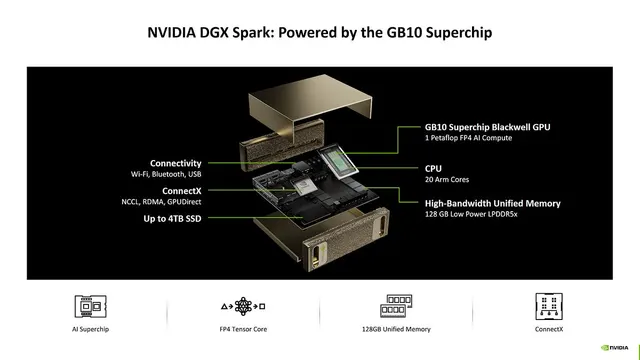
Chips and Cheese conducts an independent technical analysis of Nvidia's GB10 integrated GPU, examining its microarchitecture, performance characteristics, and design tradeoffs in Nvidia's large iGPU effort aimed at AI workstation use.
Few outlets run their own low-level benchmarks on unreleased or niche AI silicon. Useful reference for evaluating Digits-class workstations before purchase.